

How Often Should You Use Clarifying Shampoo? By Hair Type
Buildup from styling products, hard water minerals, and silicones can make textured hair feel heavy, dull, and impossible to style. A clarifying shampoo cuts through all of that, but use it too often, and you strip away the natural oils your curls, coils, and waves actually need. So how often should you use clarifying shampoo without drying out your hair? The answer depends on a few things.
Your hair type, how much product you use, and even your water quality all play a role in how frequently you need a deep cleanse. At scatterhair, we're building styling products specifically for textured hair, products designed to perform without weighing you down. But even the best styling routine needs a reset now and then.
This guide breaks down a clarifying schedule based on your hair type, the warning signs that buildup is getting out of hand, and how to avoid overdoing it. Let's get into it.
What clarifying shampoo does and when you need it
A clarifying shampoo uses stronger surfactants than your regular shampoo to remove mineral deposits, silicone buildup, and product residue that accumulate on your hair shaft and scalp over time. Regular shampoos clean surface-level dirt and oil, but they often leave behind ingredients like polyquats and heavy conditioning agents that stack up with each wash. A clarifying shampoo strips all of that away and gives your hair a true reset.
How clarifying shampoo differs from regular shampoo
Regular shampoos are formulated to be gentle enough for frequent use, which means they intentionally leave some residue behind to keep your hair feeling soft and manageable. A clarifying shampoo uses higher concentrations of cleansing agents like sodium lauryl sulfate or citric acid to cut through what your everyday shampoo cannot touch. That strength is exactly why you do not want to reach for it on every wash day, especially if your hair is naturally dry or textured. The cleaner the formula, the more your hair needs moisture immediately after you rinse it out.
Using a clarifying shampoo more than once a week on textured hair strips the natural oils your curls need to stay defined and healthy.
Signs your hair needs a clarifying wash
Your hair will tell you when buildup has taken over. Look for these specific signals before you decide how often should you use clarifying shampoo in your routine:
- Limp or weighed-down curls that will not hold their shape even with fresh product applied
- Dull or coated feeling on the hair shaft after washing
- Scalp itchiness or flakiness that your regular shampoo is not clearing up
- Styling products stop absorbing the way they used to, like your leave-in just sitting on top
- Visible waxy or white residue once your hair dries
If two or more of these describe your hair right now, buildup is almost certainly the problem. A single clarifying wash can reset your entire routine and get your styling products performing the way they are supposed to again.
Step 1. Choose the right clarifying schedule
Your hair type is the single most important factor in deciding how often should you use clarifying shampoo. Textured hair produces less sebum than straight hair, which means it loses moisture faster when you over-cleanse. Matching your clarifying frequency to your curl pattern protects your hair's natural oils while still clearing buildup before it causes real problems.
Clarifying frequency by hair type
The coarser and drier your natural texture, the less often you need a clarifying wash. Use the table below as your starting point, then adjust up or down based on how your hair actually feels week to week.
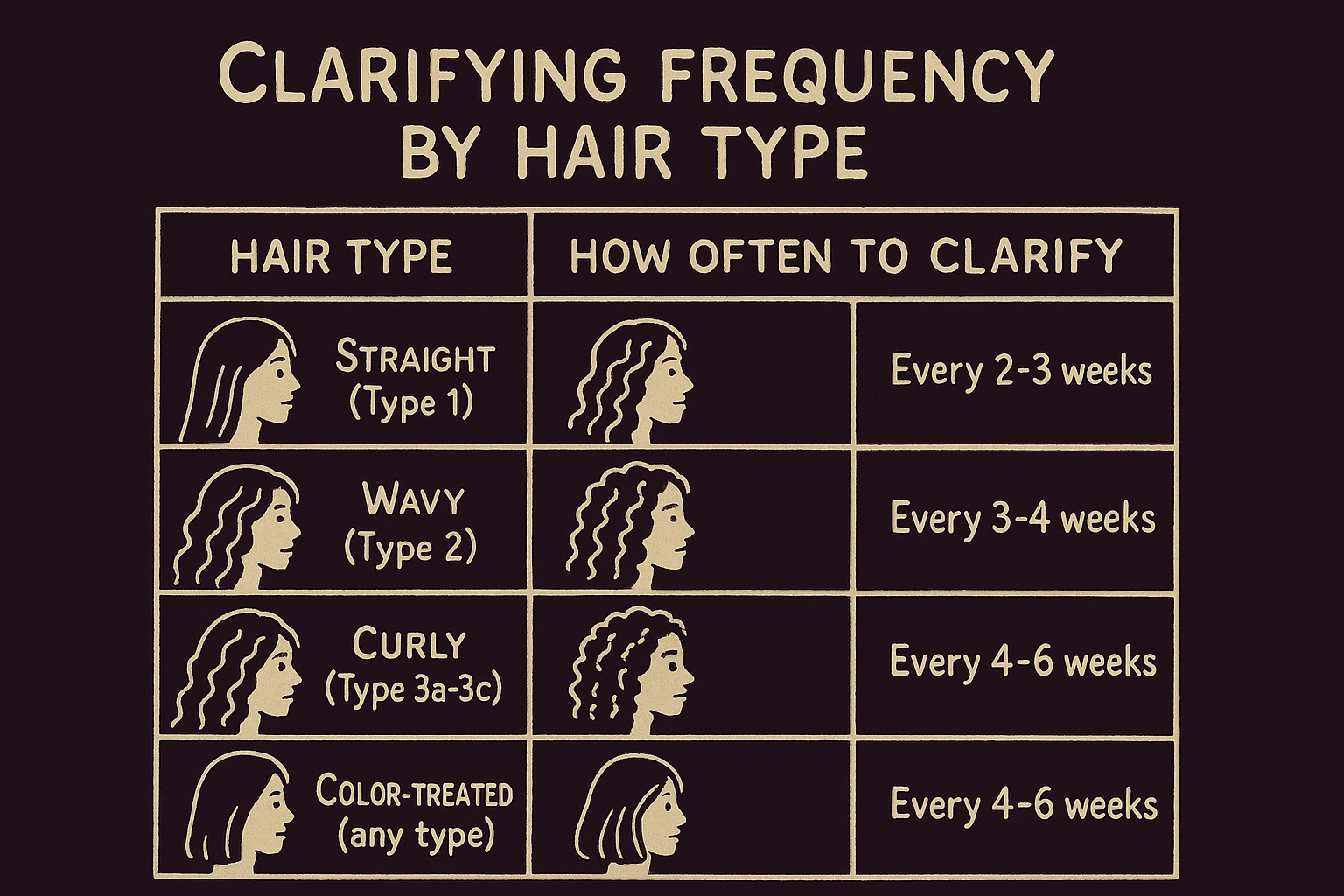
| Hair Type | Texture | How Often to Clarify |
|---|---|---|
| Straight (Type 1) | Fine to medium | Every 2-3 weeks |
| Wavy (Type 2) | Fine to medium | Every 3-4 weeks |
| Curly (Type 3a-3c) | Medium to coarse | Every 4-6 weeks |
| Coily (Type 4a-4c) | Coarse to kinky | Every 6-8 weeks |
| Color-treated (any type) | Any | Every 4-6 weeks |
Start at the longer end of the range if your hair already feels dry or shows any breakage. Fine and straight hair tolerates clarifying more frequently because it accumulates oil and silicone residue much faster and has less risk of drying out from a stronger cleanse.
If your hair feels brittle or snaps more easily after a clarifying wash, extend your schedule by two weeks and follow immediately with a deep conditioning treatment.
Step 2. Adjust for hard water, pools, and products
Your base schedule from Step 1 answers the core question of how often should you use clarifying shampoo based on your hair type, but external factors can push buildup into overdrive faster than your texture alone predicts. Hard water, chlorine, and heavy styling products all accelerate the rate at which your scalp and strands collect residue, which means you may need to clarify more often than the table in Step 1 suggests.
Hard water and chlorine exposure
Hard water contains calcium and magnesium minerals that bond to your hair shaft with every wash. Over time, those deposits dull your color, stiffen your curl pattern, and make it harder for moisture to penetrate. If you shower in hard water or swim in a chlorinated pool regularly, add one extra clarifying wash per month on top of your hair type schedule. Swimmers who train multiple times a week should clarify within 24 hours of a pool session to prevent chlorine from sitting on the hair shaft.
If you live in a hard water area, a chelating shampoo that specifically targets mineral deposits will remove buildup more effectively than a standard clarifying formula.
Heavy product users
Layering gels, creams, and oils is standard practice for textured hair styling, but every additional product increases how quickly buildup forms. If you apply three or more products on each wash day, shift your clarifying frequency to the shorter end of your hair type range. Track how your hair feels mid-cycle, and clarify early if your curls stop absorbing moisture properly.
Step 3. Clarify correctly on wash day
How you apply a clarifying shampoo matters just as much as how often you use clarifying shampoo in your routine. Rushing the process or rinsing too quickly limits how much buildup actually lifts off your scalp and strands. Follow this sequence on your next wash day to get a complete reset every single time.
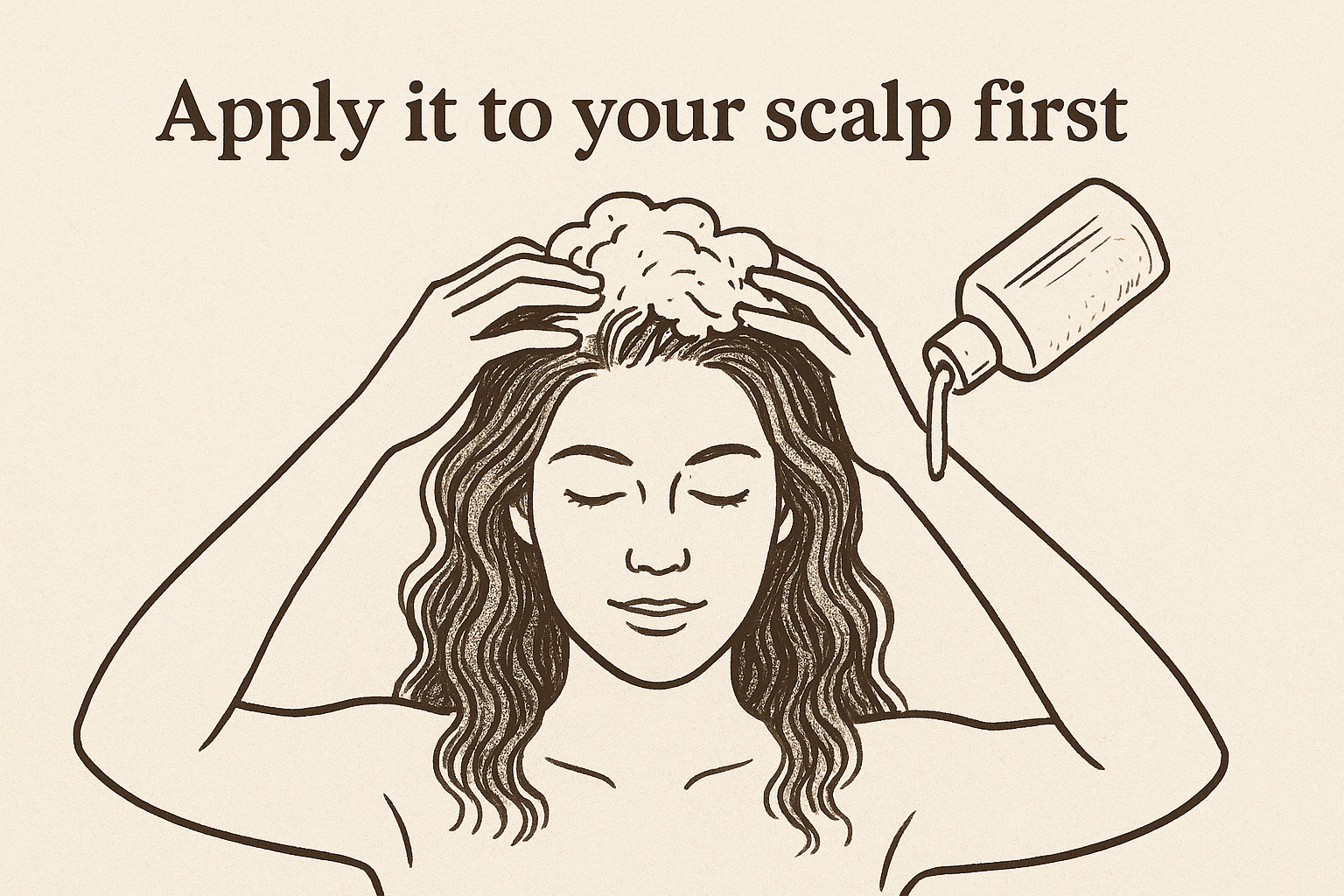
Apply it to your scalp first
Start by thoroughly saturating your hair with warm water before you squeeze out any product. Warm water opens the hair cuticle, which allows the surfactants in the clarifying shampoo to penetrate more effectively. Apply the shampoo directly to your scalp and work it in with the pads of your fingers in small circular motions. Let it sit for two to three minutes before you work the lather down the length of your hair. Avoid scrubbing your ends aggressively since the runoff from your scalp rinse is usually enough to clear residue from the mid-lengths and tips.
Rinse your hair with cool water at the end of your clarifying wash to close the cuticle and reduce frizz before you apply any conditioning products.
Follow up with deep conditioning
A clarifying shampoo removes everything from your hair shaft, including the natural oils your curls rely on for softness and definition. Apply a deep conditioner or a protein-free moisturizing mask immediately after every clarifying wash and leave it on for a minimum of 10 to 15 minutes before rinsing. Skipping this step is the fastest way to turn a reset wash into a dryness problem.
Step 4. Avoid damage and color fade
Clarifying shampoo is one of the most effective tools in your wash day routine, but it also carries real risk if you skip a few protective steps. Color-treated hair and chemically processed strands are especially vulnerable because the cuticle is already lifted and porous, which means a strong cleansing formula pulls out dye molecules faster than it would on natural hair.
Protect color-treated hair
If your hair is color-treated, how often you use clarifying shampoo directly affects how long your color stays vibrant. Stick to every four to six weeks regardless of your curl pattern, and always apply a color-safe conditioner or bond-repair treatment immediately after rinsing. Chelating shampoos designed for color-treated hair remove mineral buildup without stripping pigment as aggressively as standard formulas.
Applying a few drops of hair oil to your ends before your clarifying wash creates a light barrier that reduces moisture loss without blocking the shampoo from cleaning your scalp.
Watch for over-clarifying signs
Your hair gives you clear signals when you are clarifying too frequently. Pull back your schedule by two weeks if you notice any of the following:
- Increased shedding or breakage at the mid-shaft
- Curl pattern that looks looser or less defined after washing
- Persistent dryness that does not resolve after deep conditioning
- Scalp irritation or redness that appears after wash day
If two or more of these show up, your clarifying frequency is too high for your hair's current condition.
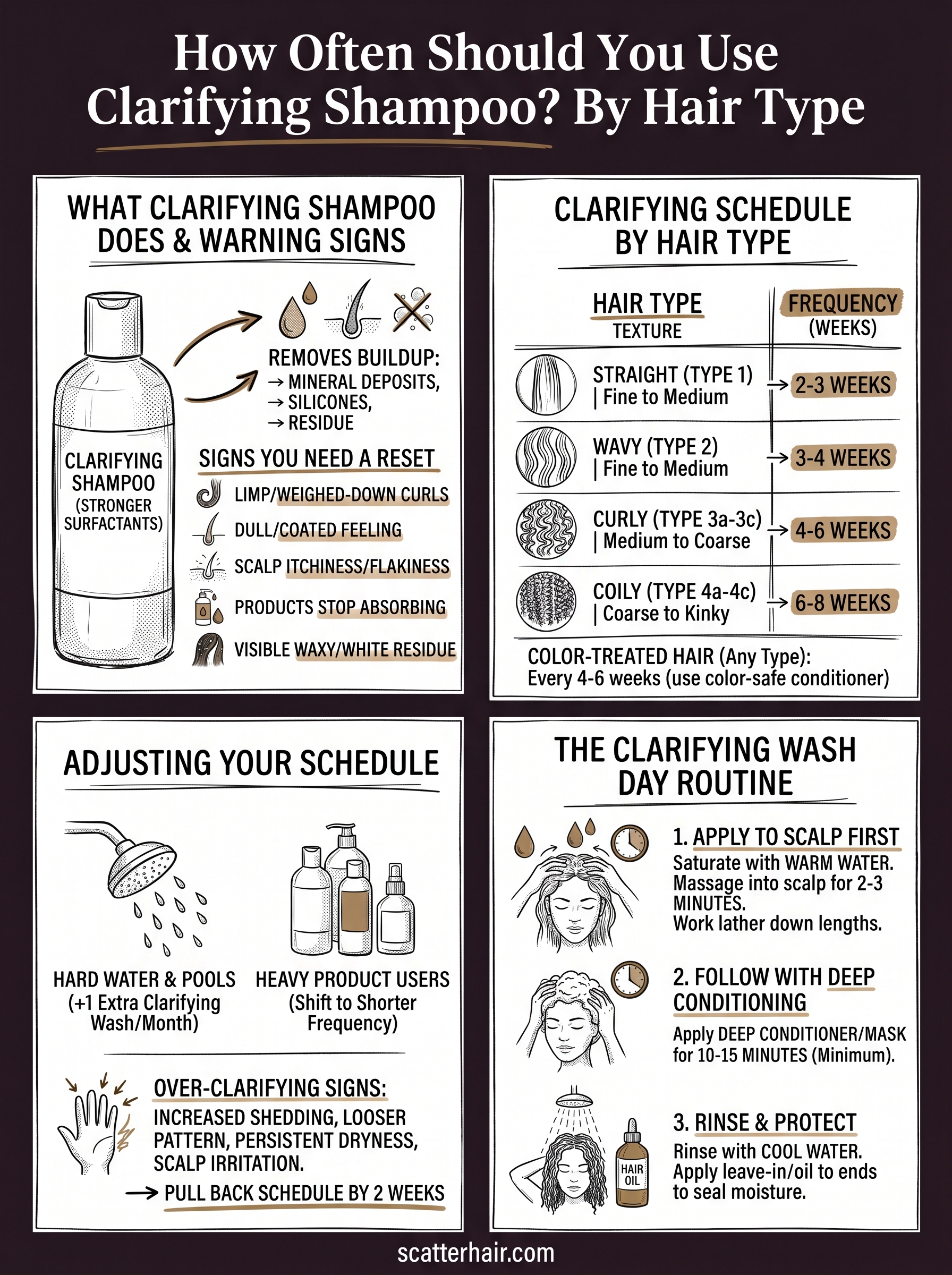
Your next wash day, simplified
Figuring out how often should you use clarifying shampoo comes down to three things: your hair type, what you put in it, and what your water does to it. Start with the schedule in Step 1, adjust based on your environment and product habits, then pay attention to how your hair responds after each clarifying wash. If it feels dry, space out your sessions by two weeks. If buildup returns quickly, tighten the schedule by a week.
The goal is a routine that keeps your curl pattern defined and your scalp clean without stripping the moisture your texture depends on. Apply a deep conditioner after every reset wash, watch for the warning signs covered in Step 4, and treat your clarifying wash as a tool rather than a regular cleanser.
Ready to build a styling routine around products made for textured hair? Check out what Scatter is building for 2026 and get early access before launch.