

How to Remove Hard Water Buildup from Hair
If your curls feel like straw no matter how much conditioner you pile on, the water coming out of your shower might be the actual problem. How to remove hard water buildup from hair starts with understanding that calcium and magnesium deposits coat every strand you wash, blocking moisture and dulling your natural texture over time.
The fix isn't complicated, but it does need to be specific. A chelating shampoo designed to bind and strip mineral deposits is your first real tool, and pairing it with an apple cider vinegar rinse helps rebalance your hair's pH so cuticles close back up and shine returns. Neither step alone solves the issue completely, which is why most people stay stuck with dry, brittle hair despite switching products constantly.
This guide walks through the exact methods that work, from store-bought clarifying treatments to DIY remedies you can mix at home tonight. You'll also learn how to tell if hard water is really your issue, and what to change in your routine so buildup doesn't creep back in. If you're working with textured hair, these steps matter even more since mineral buildup hits coils and curls harder than straighter textures.
Why hard water leaves textured hair dry and dull
Hard water carries dissolved calcium and magnesium, minerals picked up as water travels through soil and rock before reaching your pipes. Every time you rinse, those minerals settle onto your hair shaft and scalp, forming a thin film that layers up wash after wash. You can't rinse this film away with more water, since more hard water just adds another coat. Over weeks, that buildup turns into a barrier that sits between your hair and every product you apply.
How mineral deposits block moisture
The real damage happens at the cuticle level. Calcium and magnesium bond to the outer layer of your strand, and this mineral buildup physically blocks conditioner, oils, and water from soaking in. Your hair starts feeling coated instead of nourished, no matter how rich the product. You'll notice dullness first, then a texture that feels almost waxy, followed by tangling that seems to get worse even when you deep condition regularly.
Hard water doesn't just dry hair out, it seals moisture out entirely by coating the strand before conditioner ever gets a chance.
Why textured hair takes the hardest hit
Curly and coily hair already struggles to move natural oils down the shaft because of its shape, so it depends more heavily on external moisture from products. Add a layer of mineral film on top, and that dependency turns into a real problem. Coils twist and bend along their length, creating more surface area where deposits can grip, and higher porosity strands, common in textured hair, absorb minerals more readily than they absorb the moisture you're trying to restore. This is why two people can shower in the same hard water and one ends up with limp waves while the other deals with frizz, breakage, and hair that won't hold a style no matter what they use.
Signs you're dealing with hard water buildup
Before jumping into treatment, confirm what you're actually up against:
- Hair feels stiff or waxy within a day of washing, even with conditioner
- Color looks faded or dull, especially on treated or highlighted hair
- Products stop lathering the way they used to, including shampoo
- Scalp feels itchy or tight after showers
- White or chalky residue appears around your showerhead or faucet
If several of these sound familiar, hard water is likely working against your hair, and the next steps in this guide are built specifically to strip that buildup and get moisture flowing again.
Step 1. Clarify with a chelating shampoo
A chelating shampoo is your first move because it's built to grab onto calcium and magnesium ions and lift them off your strands, something a regular shampoo simply can't do. Look for one with ingredients like EDTA, citric acid, or a chelating agent listed near the top of the ingredient panel. These formulas bind to mineral deposits on a molecular level, pulling them away from your hair shaft so water and conditioner can actually reach the strand instead of sliding off a mineral coating.
Skip the chelating step and every other product you use afterward is fighting a losing battle against a mineral wall it can't get through.
How to use it without over-drying
Chelating shampoos strip hard, so treat this like a reset, not a daily habit. Use it once a week to start, twice if your water is especially hard or you notice buildup returning fast.
- Wet hair thoroughly with warm water for at least 30 seconds before applying shampoo.
- Massage the shampoo into your scalp and work it through to the ends, focusing on areas that feel waxy or coated.
- Let it sit for two to three minutes so the chelating agents have time to bind to mineral deposits.
- Rinse completely, then follow immediately with a moisturizing conditioner since clarifying strips natural oils along with the buildup.
Overusing a chelating shampoo can leave textured hair feeling stripped and frizzy, so watch how your curls respond and dial back frequency if they start feeling rougher instead of softer. This step alone won't rebalance your hair's pH, though, which is exactly what the next step handles.
Step 2. Rinse with diluted apple cider vinegar
Once the chelating shampoo has stripped away mineral buildup, your hair's cuticle is left rough and slightly raised, which is exactly why the next move matters. An apple cider vinegar rinse works as a natural acid that lowers your hair's pH back to where it should sit, closing the cuticle so strands lay smooth and reflect light instead of scattering it. Vinegar also breaks down any leftover mineral residue the shampoo missed, giving you a second pass at removing hard water damage without another round of harsh cleansing.
Closing the cuticle with an acidic rinse is what turns a clarified wash into actual shine, not just clean hair.
Getting the ratio right
Too much vinegar burns your scalp and strips more than it helps, so dilution is non-negotiable. Mix this ratio and apply right after rinsing out your chelating shampoo:
1 part apple cider vinegar
4 parts cool water
(example: 1/4 cup ACV + 1 cup water)
Pour the mixture over damp hair, focusing on your ends where cuticle damage from mineral buildup tends to concentrate. Let it sit for two to three minutes, then rinse with cool water, since cool temperatures help seal the cuticle further instead of reopening it.
How often to rinse
Doing this every wash day is too aggressive for most textured hair, especially if you're already clarifying weekly. Stick to once a week alongside your chelating shampoo, or every other wash if your strands feel tight or overly smooth afterward. Textured hair with higher porosity absorbs the acid faster, so shorten the sit time to a minute if you notice any tingling or dryness creeping in over the following days.
Step 3. Deep condition to restore moisture
After clarifying and rinsing with vinegar, your hair is clean but hungry. Both steps strip moisture along with mineral buildup, so deep conditioning is where you actually put water and nutrients back into the strand instead of just removing what was blocking them. Reach for a moisture-rich deep conditioner with humectants like glycerin or aloe, plus emollients such as shea butter or fatty alcohols, since these ingredients penetrate the cuticle you just closed and rebuild flexibility that hard water damage stripped away.
Clarifying without deep conditioning right after just leaves your hair clean and thirsty instead of clean and healthy.
Getting the most from this step
Heat helps the conditioner actually absorb instead of sitting on the surface, which matters even more on textured hair that struggles to pull moisture down the shaft on its own.
- Apply generously to damp, freshly rinsed hair, focusing on mid-lengths and ends.
- Cover with a shower cap or plastic wrap to trap heat and humidity.
- Sit under a hooded dryer or warm towel for 15 to 20 minutes.
- Rinse with cool water to seal everything back in.
Using a deep conditioner formulated specifically for textured, high-porosity hair makes a real difference here, since generic formulas often can't replace what mineral buildup pulled out. Restoring that moisture is exactly the groundwork Scatter's upcoming styling line is built around, so if you want a preview of formulas made for this kind of texture, joining the email list gets you early access. Repeating this treatment weekly, right after clarifying and rinsing, keeps hair soft enough to actually hold a style instead of fighting it.
Step 4. Prevent buildup with a shower filter
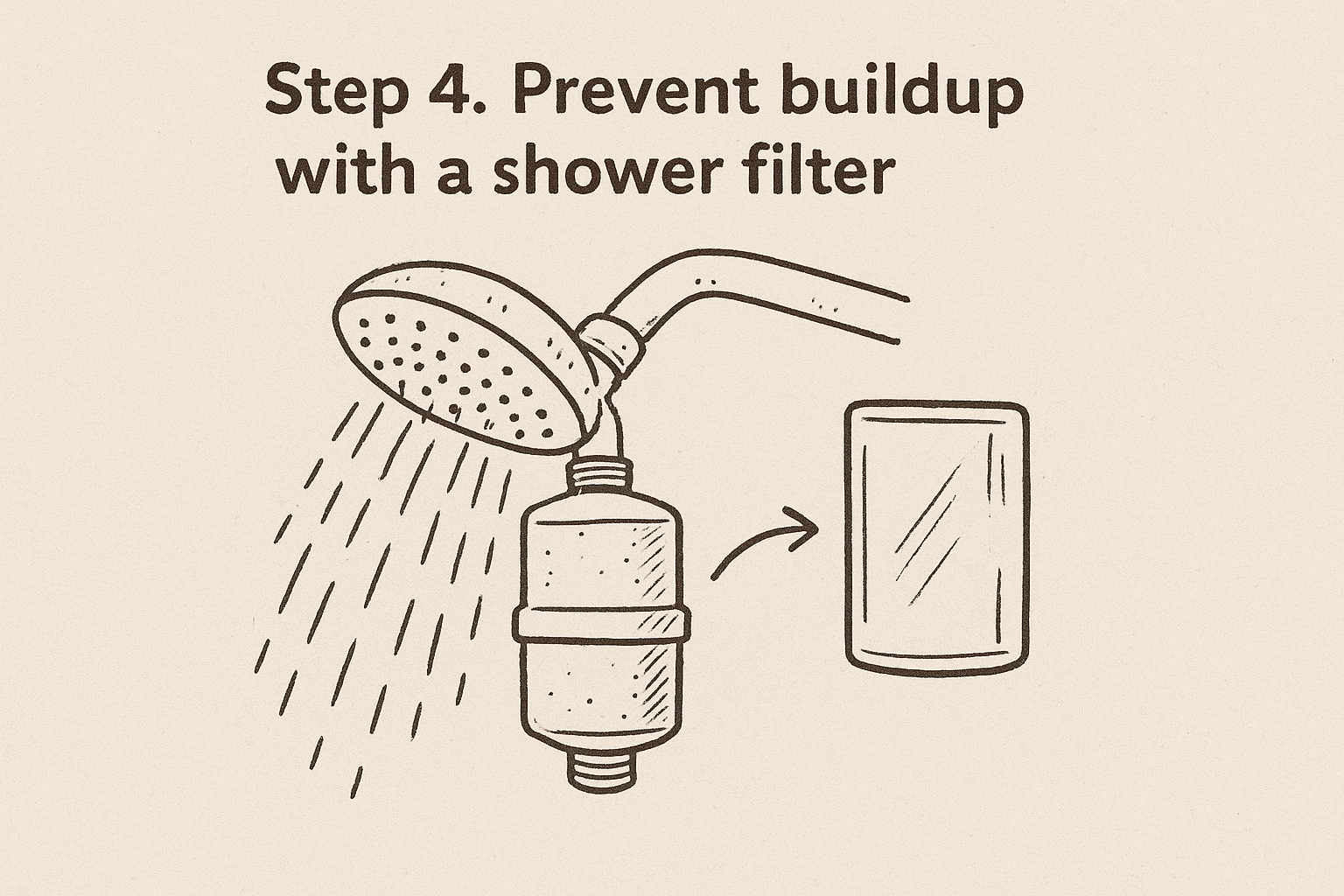
Clarifying and rinsing fix damage that's already done, but they won't stop the next round of mineral buildup from forming the moment you step back into hard water. A shower filter installed on your showerhead catches calcium and magnesium before they ever touch your hair, so you're not stuck repeating the same repair cycle every single week. Most filters use a mix of KDF media and activated carbon to reduce mineral content, and installation takes about ten minutes with no plumber required.
Fixing hard water damage without filtering your water is like mopping a floor while the faucet keeps leaking.
Choosing a filter that actually works
Not every filter marketed for hair holds up, so check for a few specifics before buying:
- Filter media includes KDF-55 or vitamin C, both proven to reduce chlorine and mineral content
- Flow rate stays strong, since some filters cut water pressure enough to make rinsing frustrating
- Cartridge lasts 3 to 6 months under daily use, with a clear replacement indicator
- Fits your existing showerhead without needing new plumbing
Keeping the filter working long term
A filter only helps while its cartridge still has capacity, and hard water burns through that capacity faster than city water with lower mineral content. Replace cartridges on schedule rather than waiting until buildup symptoms return, since by then the filter has already stopped doing its job. Pairing this filter with your weekly chelating and vinegar routine gives you a full defense: one step removes what's already there, the other keeps new buildup from forming.
Healthier hair starts at the tap
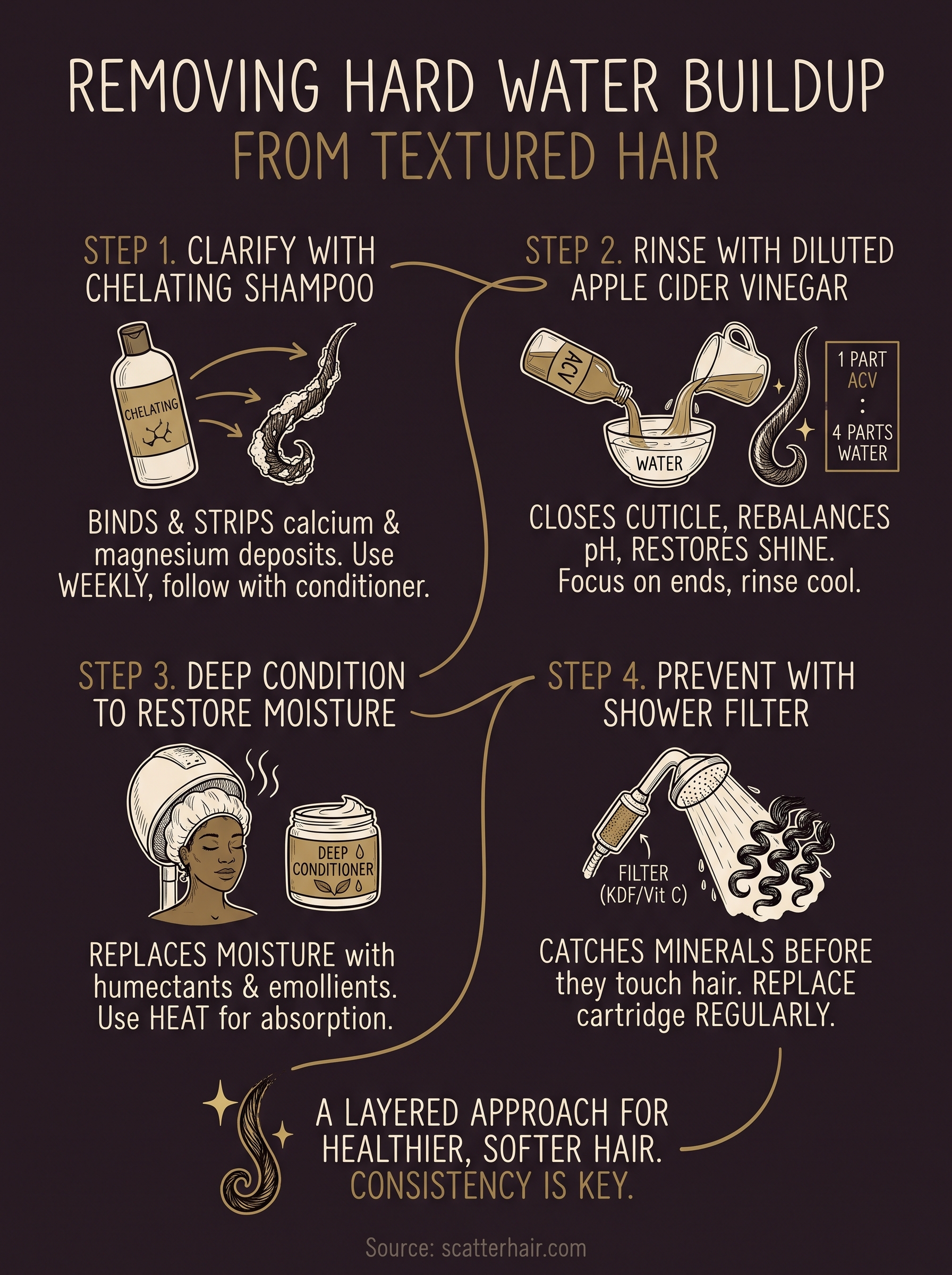
Hard water damage builds slowly, so fixing it takes the same layered approach: strip what's already there, rebalance your cuticle, replace the moisture you lost, then stop new buildup from forming. Skip any one of these four steps and you're back to square one within a few weeks. Once you've run through chelating, rinsing, and deep conditioning, and you've got a shower filter catching minerals before they reach your hair, you'll notice softness and shine returning in ways regular products alone never delivered.
Getting your water quality under control isn't a one-time fix, it's a routine you keep running as long as hard water comes out of your tap. Textured hair rewards that consistency fast, holding styles longer and tangling less within just a few weeks. If you want formulas built specifically for that kind of moisture-hungry, high-porosity hair, join Scatter's email list for early access when the line launches.