

How to Style Long Curly Hair for Men: A Complete Guide
Growing your curls out is the easy part. Keeping them from turning into a frizzy, shapeless mess by month three is where most guys get stuck. You're not dealing with a bad haircut, you're dealing with a routine that doesn't match your texture, and that gap is exactly what how to style long curly hair man searches are trying to close.
Here's the direct answer: styling long curly hair as a man comes down to three things, the right wash-day routine, products built for curl definition instead of weight, and a drying method that locks in shape instead of fighting it. Skip any one of those and the rest of your effort is wasted. This applies whether you've got loose waves or thick curly hair male patterns that need extra hold.
In this guide, you'll get a full breakdown of curl types and what they actually need, step-by-step techniques for men with curly hair at every length, product picks that won't leave you crunchy or greasy, and a handful of low-maintenance styles you can pull off before coffee. If you've been improvising your routine, this is where it stops.
Understanding your curl type and hair needs
Before you touch a single product, you need to know what pattern you're actually working with. Curl type determines everything downstream, how much moisture your hair holds, how much product weight it can handle, and how it reacts to humidity. Guys skip this step constantly and then wonder why the routine their buddy swears by leaves their hair either greasy or dry as straw. Long hair makes this worse because gravity pulls on every strand, stretching waves into limp lines and dragging tight coils down into a bigger, looser shape than they'd have if cut short.
The curl type chart, from waves to coils
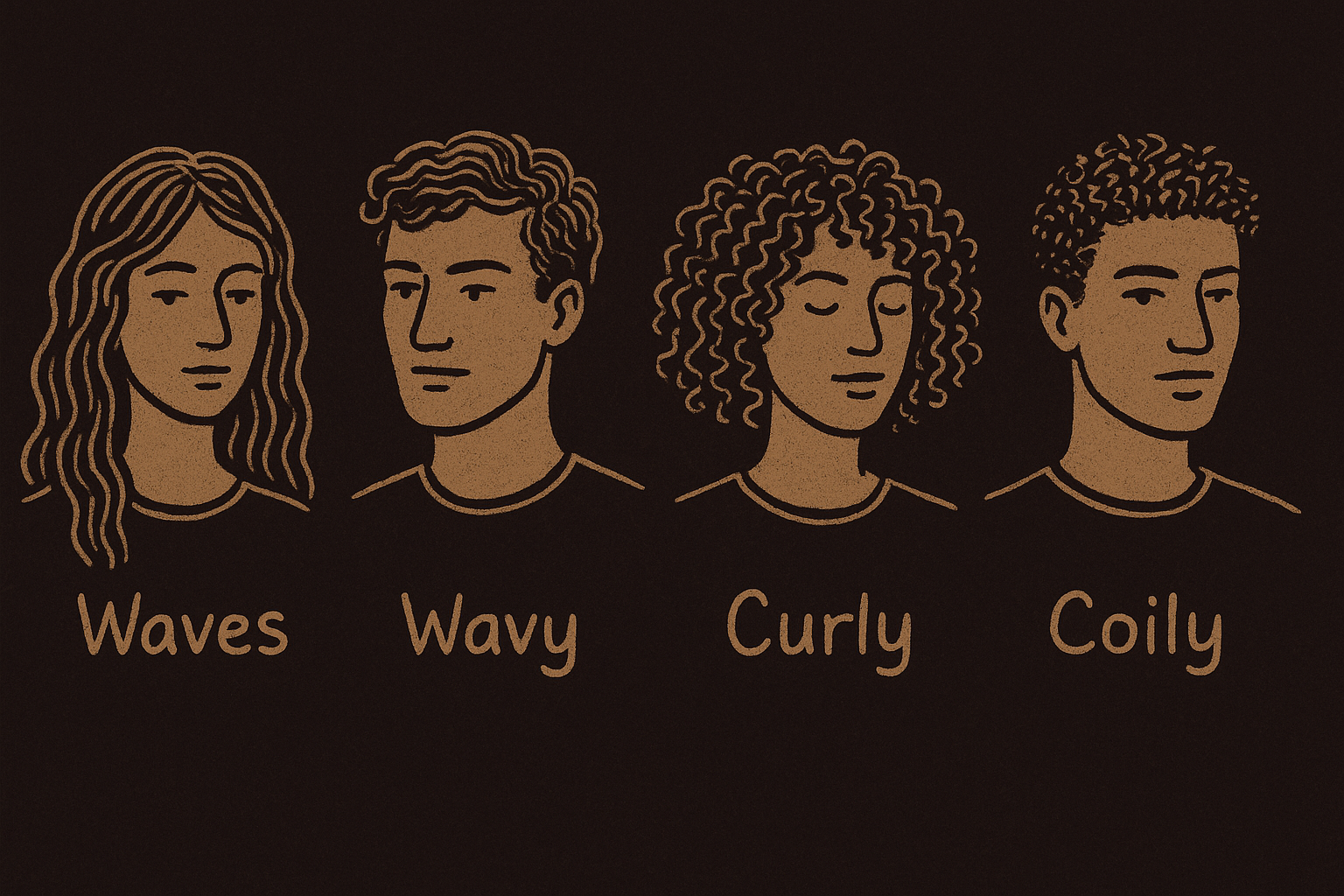
The hair typing system runs from type 2 (wavy) through type 4 (coily), with A, B, and C subcategories marking how tight the pattern gets. Most men chasing how to style long curly hair for men results fall somewhere in 2C to 3C, but plenty of guys with type 4 patterns grow their hair long too, and that changes the entire approach.
| Curl Type | Pattern | Common Needs |
|---|---|---|
| 2A-2B | Loose waves, S-shaped | Lightweight products, avoid heavy oils |
| 2C-3A | Defined waves to loose curls | Medium hold cream, some moisture boost |
| 3B-3C | Springy curls to corkscrews | Rich leave-in, curl cream, anti-frizz serum |
| 4A-4C | Tight coils to Z-pattern | Heavy moisture, butters, low manipulation styling |
Your curl type tells you how much moisture and hold your hair needs, not how much product you should dump on it.
Porosity changes how products behave on your hair
Knowing your curl pattern only gets you halfway there. Hair porosity, meaning how well your strands absorb and hold moisture, decides whether a product actually works or just sits on top of your hair doing nothing. Low porosity hair has tightly closed cuticles and repels moisture, so lightweight, water-based products applied to damp hair work best. High porosity hair, often from heat damage or color treatments, soaks up moisture fast but loses it just as quickly, so it needs heavier creams and a sealing oil to lock hydration in. You can do a quick test at home: drop a clean strand of shed hair into a glass of water. If it sinks fast, you've got high porosity. If it floats for a while, you're low porosity.
Long hair has different demands than short curls
Growth changes the game entirely. Once your curls pass ear length, weight starts working against your pattern, and the same routine that gave you tight, bouncy curls at three inches can leave you with stretched, frizzy waves at eight. This is where techniques for men with curly hair need to shift toward richer leave-ins, stronger hold creams, and drying methods built to fight gravity instead of ignoring it. Men with thick curly hair male patterns feel this most, since thick strands hold more water and take longer to dry, which means more time for frizz to creep in if you're not using the right technique.
Once you know your curl type, your porosity, and how length is affecting your pattern, the rest of this guide gets a lot more useful. Every step from here builds on that foundation, so if you skipped the strand test, go back and do it now before you start step one.
Step 1. Wash without stripping your curls
Most guys ruin their curls before they ever pick up a styling product. Sulfate-based shampoos strip your scalp's natural oils along with every bit of moisture your curls need to hold their shape, leaving you with hair that frizzes the second you step outside. That squeaky-clean feeling you got from drugstore shampoo growing up is actually a warning sign, not a win. Long curly hair depends on retained oil to travel down the strand, and sulfates cut that process off at the root.
Switch to a sulfate-free or low-poo cleanser
Read the label before you buy anything. Look for sulfate-free shampoo formulas or a co-wash (conditioner-based cleanser) if your curls lean high porosity or type 3B and coarser. Co-washing skips detergent entirely and relies on gentle surfactants to lift dirt without touching your natural oils, which works well for guys who don't use heavy styling products daily. If you're using gel or wax most days, stick with a sulfate-free shampoo instead, since co-washing alone won't clear that buildup.
Skip the sulfates, and you skip the frizz before it even starts.
Wash less often than you think you should
Curly hair doesn't need daily washing, and washing too often is one of the fastest ways to undo everything else in your routine. Twice a week is plenty for most curl types, three times max if you sweat heavily or use a lot of product. On non-wash days, rinse with water only and use your fingers to redistribute scalp oil down the length of your hair.
Wash technique matters as much as the product
How you wash counts for just as much as what you wash with. Follow this sequence every time:
- Soak your hair fully with warm (not hot) water for at least a minute
- Apply shampoo or co-wash directly to your scalp, not the lengths
- Massage with your fingertips, never your nails, for 60 seconds
- Let the lather run down your curls as you rinse, don't scrub the ends
- Finish with a cool water rinse to help close the cuticle
Getting this step right sets up everything that follows. Skip the sulfates, respect your wash frequency, and treat your scalp gently, and you've already solved half the frizz problems men blame on bad genetics.
Step 2. Detangle and condition the right way
Skip detangling before you shampoo and you'll spend the next ten minutes ripping through knots that snap your strands and shred your curl pattern. Long curly hair tangles fast because every strand wraps around its neighbors as it grows, and forcing a brush through dry curls breaks more hair than a bad haircut ever could. The fix is simple: detangle while your hair is soaked and coated in slip, never dry.
Detangle in the shower, not before it
Apply a generous amount of conditioner to soaking wet hair and let it sit for a minute before you touch a tool. The conditioner coats each strand and gives your fingers or comb something to glide through instead of catch on. Work section by section instead of attacking the whole head at once.
- Divide your hair into four quadrants and clip three out of the way
- Start finger-detangling at the ends, working upward toward the roots
- Switch to a wide-tooth comb only after your fingers move through smoothly
- Rinse conditioner out with cool water once every knot is gone
Detangle in the shower with conditioner in your hair, and you'll never fight a dry knot again.
Choose a conditioner built for curl length, not just curl type
A thin, watery conditioner made for straight hair won't cut it once your curls pass shoulder length. You need a rich conditioner with real slip, something formulated with fatty alcohols and emollients that coats the full length of a long strand instead of rinsing off in seconds. Guys with thick curly hair male patterns should look for deep conditioning masks once a week on top of daily conditioner, since thick strands take longer to fully hydrate and dry out faster once they do.
Don't skip the rinse, but don't overdo it either
Rinsing your conditioner out matters as much as applying it. Leave too much in and you'll end up with limp, weighed-down curls by midday. Rinse too aggressively and you strip the moisture you just worked to add. Aim for a cool rinse that clears the bulk of the product while leaving a light film behind, that residual layer is what keeps your curls soft through the detangling and drying steps still ahead. Get this balance right and your hair will already feel more manageable before you apply a single styling product.
Step 3. Apply leave-in conditioner for lasting hydration
Rinse-out conditioner solves half your moisture problem, but long curls need a second layer of hydration that stays put through drying, styling, and the eight or ten hours you'll spend out in dry office air or summer heat. A leave-in conditioner does exactly what the name says: it stays in your hair instead of washing out, feeding moisture to your strands all day instead of just during the shower. Skip this step and you're asking your styling product to do a job it was never built for.
Why leave-in matters more as hair gets longer
Gravity is the enemy here again. The tips of long curly hair are the oldest, most damaged part of the strand, sometimes years old if you haven't trimmed in a while, and they're furthest from your scalp's natural oil supply. Without a leave-in, those ends dry out first and frizz first, dragging the rest of your curl pattern down with them. Guys asking how to style long curly hair men routines around often overlook this step entirely and then blame their curl cream for frizz that a leave-in would have prevented.
A leave-in conditioner is what keeps your ends from drying out hours before the rest of your hair does.
How to apply it without weighing your curls down
Apply your leave-in to hair that's still dripping wet, right after you step out of the shower and squeeze out excess water with a microfiber towel or cotton t-shirt. Follow this order for the best result:
- Section your hair into two or four parts, same as you did for detangling
- Rake a coin-sized amount through each section from mid-length to ends
- Flip your head upside down and scrunch upward toward the scalp
- Add a second small amount to your crown and part if that area runs drier
Drier climates and coarser, thick curly hair male patterns can handle more product here without going limp. Fine or looser 2A-2B waves should stick to a lighter application, since too much leave-in on thin strands just weighs the wave pattern flat. If you're building a routine from scratch and want a formula made specifically for textured hair instead of a generic drugstore option, Scatter's product lineup is built around exactly this kind of curl-first hydration.
Step 4. Pick a styling product that matches your curls
Once your leave-in is in place, the next product you add decides whether your curls hold their shape or collapse by noon. Curl-defining products fall into three main categories: gels, creams, and custard-style formulas, and picking the wrong one for your curl type is the single biggest reason guys end up either crunchy or frizzy by midday. Gels bring the strongest hold and work best for looser waves or fine 2A-2B patterns that need help staying curled. Creams add moisture and light hold, which suits 3A-3B curls that already spring back on their own. Thicker custards and butters give the heaviest hold and moisture combo, exactly what thick curly hair male patterns in the 3C-4C range need to fight both frizz and gravity.
Match product weight to your curl density
Density, meaning how many strands you have per square inch of scalp, matters just as much as curl pattern when picking a product. Low-density hair goes flat under heavy creams, no matter how curly the pattern is. High-density hair swallows lightweight gels without ever getting the hold it needs.
| Density | Best Product Type | Application Amount |
|---|---|---|
| Low | Light gel or mousse | Dime-sized |
| Medium | Curl cream | Quarter-sized |
| High | Custard or butter | Half-dollar sized |
The right product isn't the strongest one, it's the one that matches how much hair you actually have to control.
Layer products instead of picking just one
Most techniques for men with curly hair that actually hold up all day rely on layering, not a single miracle product. Try this order:
- Rake a curl cream through damp hair for moisture and light hold
- Follow with a small amount of gel on top for structure
- Scrunch upward from ends to roots to encourage clumping
- Skip touching your hair again until it's fully dry
This layering method, often called "cream and gel" or LOC (leave-in, oil, cream) styling, gives you moisture underneath and hold on top. Guys chasing how to style long curly hair guys routines that hold through a full workday usually land here after trial and error, so save yourself the guesswork and start with layering instead of a single product.
Step 5. Dry your curls without causing frizz
Drying is where most long curly hair routines fall apart, because a normal towel does the exact opposite of what your curls need. Terry cloth towels have rough fibers that snag your cuticle and rough it up, which triggers frizz before your hair even finishes drying. Swap that towel out and you fix a problem you probably didn't know you had.
Plop instead of rub
Plopping means wrapping your hair up in a flat, smooth fabric right after you apply your leave-in and styling product, letting gravity and gentle pressure hold your curl pattern in place while it air-dries partway. Grab a microfiber towel or an old cotton t-shirt, lay it flat, flip your head forward, and pile your curls into the center before twisting the fabric up and securing it at the nape of your neck. Leave it on for fifteen to twenty minutes.
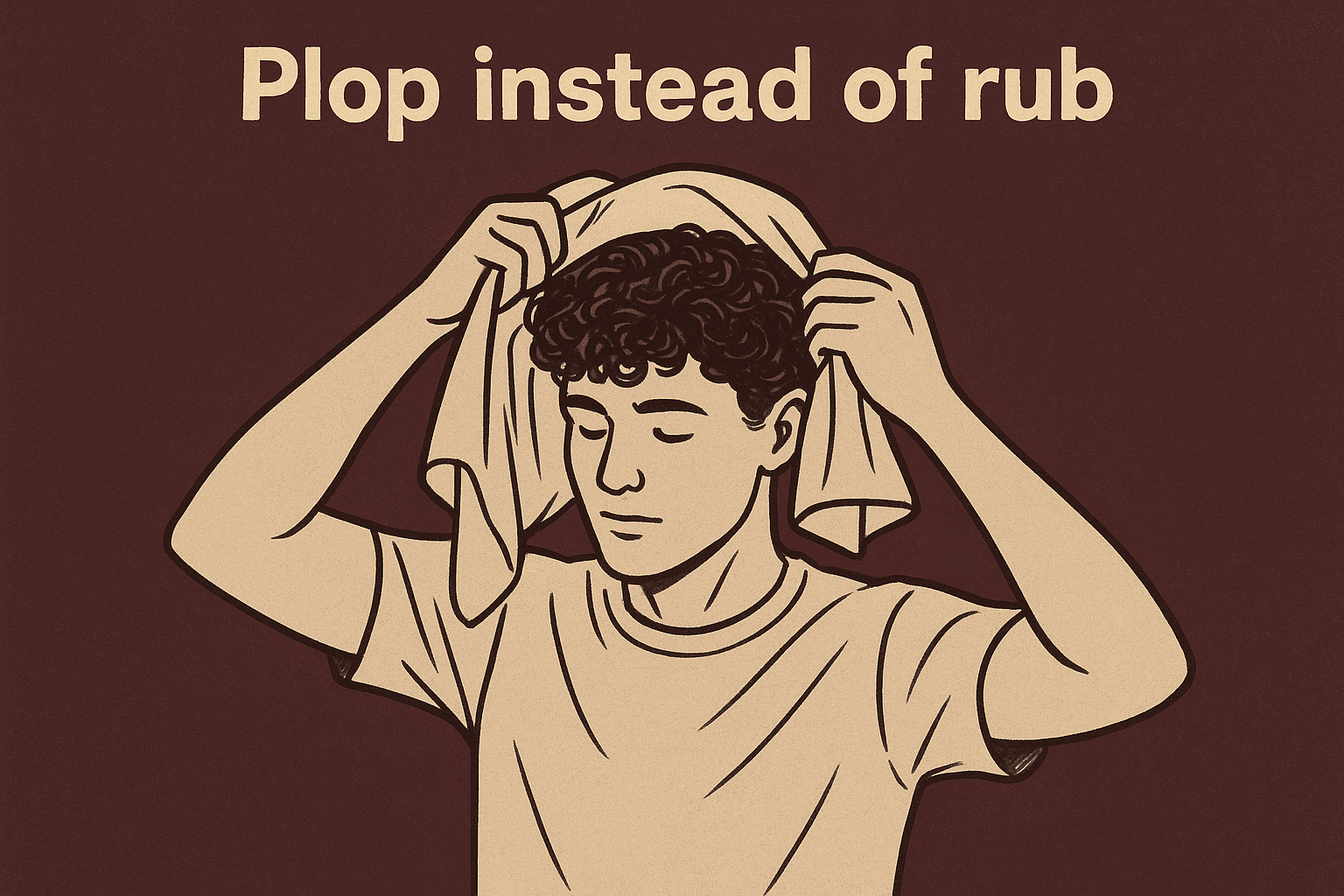
Plopping does the shaping work a towel never could, using nothing but fabric and gravity.
Diffuse on low heat for faster results
Air-drying alone can take hours on long, thick curls, and that extra drying time gives frizz more room to creep in. A diffuser attachment on your blow dryer solves this by spreading airflow evenly instead of blasting your curls straight and frizzy. Run it on low heat and low speed, cupping sections of hair in the diffuser bowl and holding it against your scalp rather than moving it around.
- Set your dryer to low heat, low speed
- Cup small sections in the diffuser and hold, don't swirl
- Work from the underside up toward your crown
- Stop at 80% dry and let the rest air-dry
Stopping short of fully dry matters more than most guys realize. Pulling curls to bone-dry with direct heat is one of the fastest ways to trigger frizz on thick curly hair male patterns, since the outer layer dries and hardens while moisture is still trying to escape from underneath.
Never touch your curls while they're drying
Touching, scrunching, or running your fingers through curls mid-dry breaks the clumps you worked to form during styling. Resist the urge until your hair is completely dry, then handle it as little as possible when you do. Every guy who's mastered how to style long curly hair for men routines will tell you the same thing: hands off is the hardest rule to follow and the one that matters most.
Step 6. Set your style and keep frizz away all day
Drying gets you 90% of the way there, but a few finishing moves decide whether your curls hold shape through a full day of meetings, workouts, or humidity. Frizz-free styling at this stage is about locking in what you already built, not adding more product on top and hoping for the best. Skip these final touches and even a great wash-and-dry routine can unravel by mid-afternoon.
Lock in your style with the right finishing product
Once your curls are fully dry, a light-hold finishing oil or serum smooths the outer layer without breaking up the clumps you spent all that time forming. Rub a few drops between your palms and lightly press it over the surface of your hair, focusing on flyaways near your crown and any frizz that popped up along the part. Don't rake it through the full length again; that motion undoes the definition drying already locked in.
The last product you touch your hair with should smooth it, not restyle it.
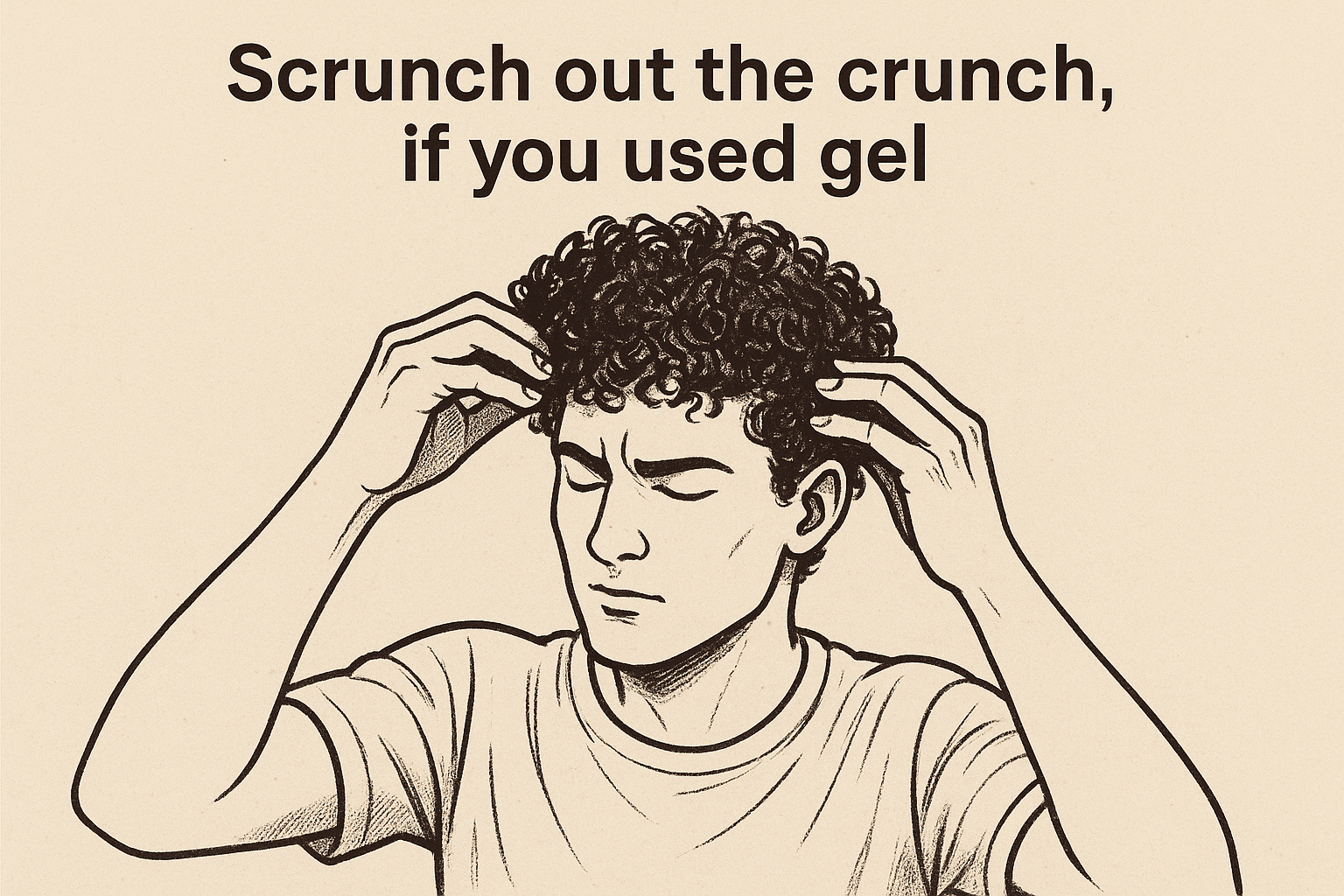
Scrunch out the crunch, if you used gel
Guys who layer gel on top of cream during styling often end up with a stiff "gel cast" once hair fully dries. That's normal, not a mistake. Once your curls are bone dry, cup a small section in your palm and gently scrunch upward to crack the cast and release soft, bouncy curls underneath. This step, often shortened to SOTC, works especially well for thick curly hair male patterns that need heavier gel for hold but still want a natural finish instead of a helmet look.
Touch-ups that don't undo your work
Humidity, sweat, and pillow friction will test your style throughout the day, so keep your fixes light instead of reaching for more product every time a curl shifts.
- Mist with plain water, not a full reapplication, to revive limp sections
- Scrunch gently with dry hands, never a comb, to reshape without frizzing
- Rub a tiny bit of leftover oil between palms for flyaways near your hairline
- Sleep on a satin or silk pillowcase to protect curls overnight instead of restyling from scratch each morning
Master these small touch-ups and your how to style long curly hair man routine holds up well past the first few hours, no matter what your day throws at it.
Making your curls work for you every day
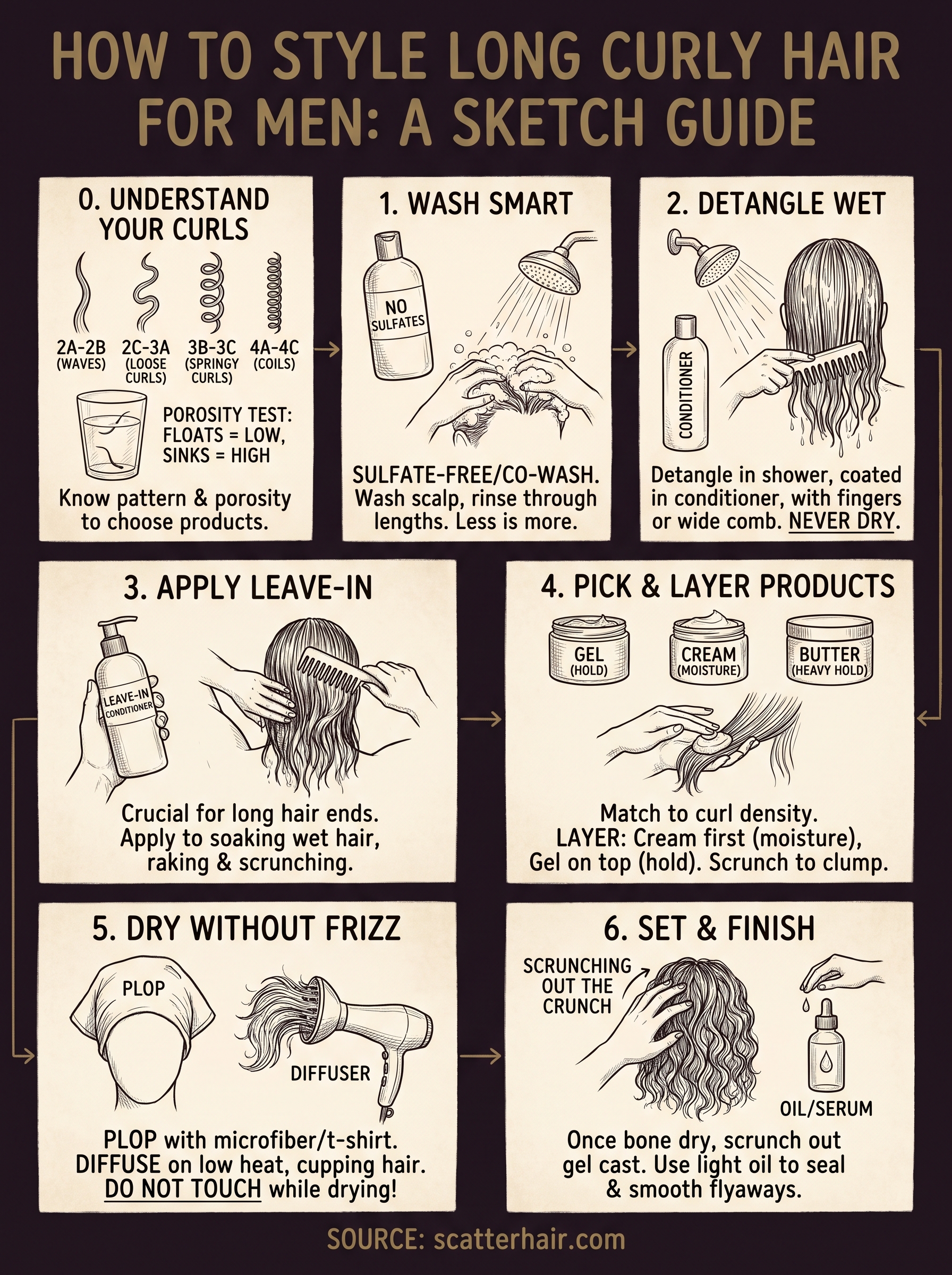
Six steps, one routine, and you've got everything you need to stop fighting your curls and start working with them. Long curly hair isn't high maintenance once you know your curl type, wash without stripping it, layer the right products, and dry with a method that respects your pattern instead of fighting it. None of this requires a salon trip or a cabinet full of products, just consistency and the right formulas for your texture.
Getting how to style long curly hair man right comes down to repeating these steps until they're second nature, not chasing a new trick every time frizz shows up. Your curls will tell you what they need once you're paying attention, and the routine above gives you the framework to listen. If you're ready to build that routine around products made specifically for textured hair, get on the list at Scatter and be first in line when the lineup launches.