

How to Build a Long Natural Curly Hair Routine
Long curly hair looks incredible when it's healthy, and looks like straw when it isn't. If your ends are dry by Thursday, your curl pattern drops out by midday, or you're rebuilding your whole style every time you wash, the problem usually isn't your curls. It's your routine, or the lack of one built for length. A long natural curly hair routine needs more structure than a shoulder-length routine because you're managing more weight, more old growth, and more surface area that dries out fast.
This guide breaks down exactly what that structure looks like, step by step, so you're not guessing between wash day and the next one. You'll get a clear curly hair care routine for natural hair that covers cleansing, conditioning, detangling, and styling in the right order, plus how often to repeat each step as your hair grows longer and needs different care at the roots versus the ends.
We built Scatter around the idea that textured hair should be effortless, not a second job, so this routine focuses on practical styling techniques and product logic you can actually stick with, not a 12-step wishlist. By the end, you'll have a repeatable natural curly hair routine built specifically for length, not a routine borrowed from someone with completely different hair.
Why long curly hair needs its own routine
Length changes the physics of your curls, not just the look of them. Long natural curly hair carries more weight per strand, and that weight pulls curls looser and straighter than they'd sit on shorter hair. A wash-and-go that bounces beautifully at chin length can hang limp at mid-back length, simply because gravity is working against the curl pattern the whole way down. This is the first thing most routines get wrong: they treat length as a styling preference instead of a structural factor that changes how much product, moisture, and hold you actually need.
Your ends and roots are aging at different rates
Consider what your ends have actually been through. Hair that reaches your waist might be three, four, even five years old at the tip, which means it's survived hundreds of wash days, heat exposure, friction against clothing, and sun damage your roots haven't touched yet. Your roots are new growth with intact cuticles and natural oil coverage from your scalp. Your ends are the oldest, most porous, most fragile part of your head, often with a cuticle layer that's lifted or worn away entirely. A natural hair care routine for curly hair that treats the whole head the same way ignores this gap, and it shows up as ends that snap, frizz, or refuse to hold a curl no matter what you put on them.
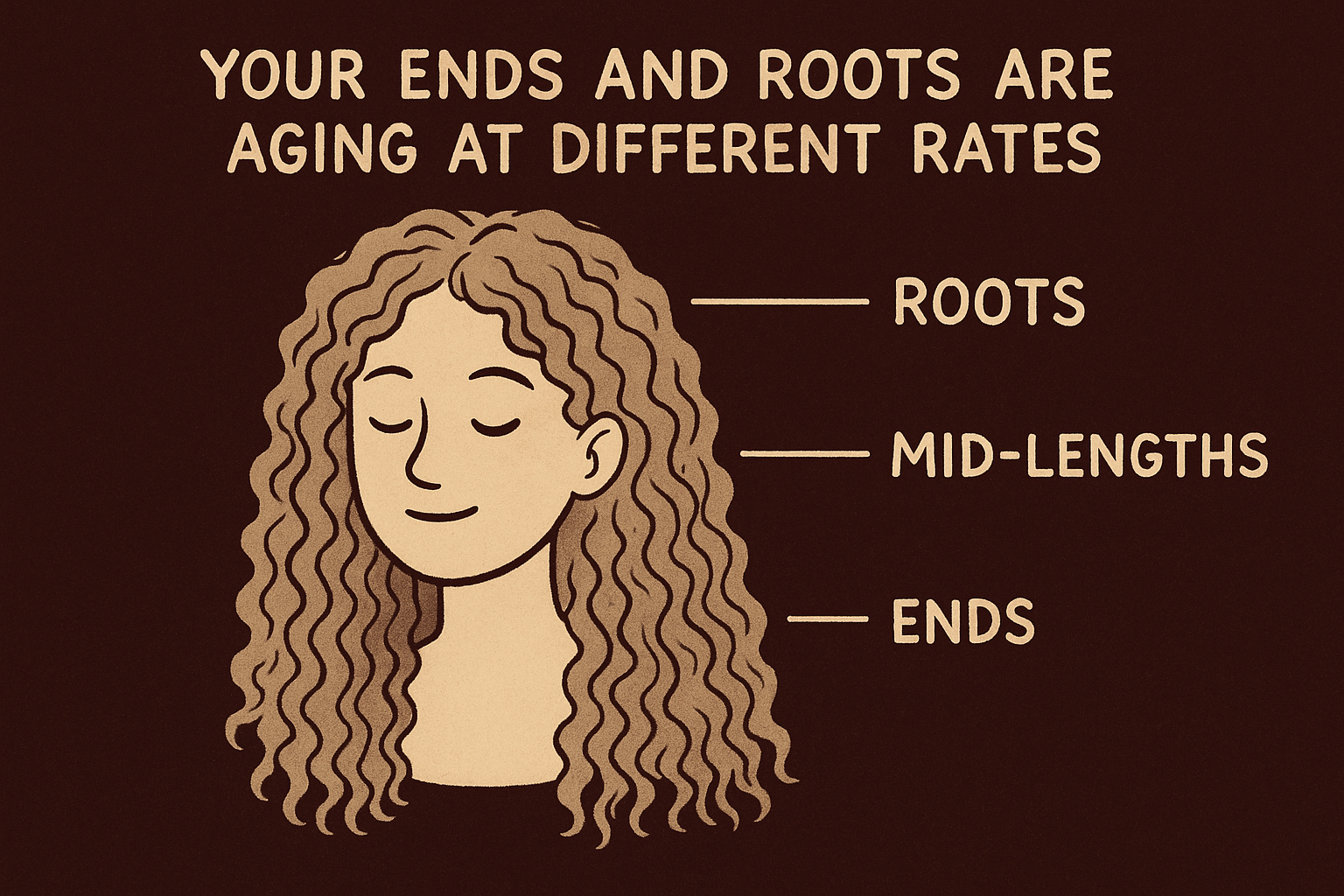
Long curly hair isn't just more hair to manage, it's two different hair types on one head, and your routine has to treat them that way.
The math on moisture and product load
Surface area is the other piece nobody talks about. More length means more strand exposed to air, heat, and friction, which means moisture evaporates faster and product gets used up faster too. A curly hair natural routine built for short hair might use a quarter-sized amount of leave-in conditioner. On long hair, that same amount barely coats the mid-lengths, let alone the ends, and you end up with a style that looks styled at the crown and dry everywhere else.
| Hair zone | Age at the tip | Main need |
|---|---|---|
| Roots (0-2 inches) | Newest growth | Scalp balance, gentle cleansing |
| Mid-lengths | 1-3 years old | Consistent moisture, detangling |
| Ends | 3+ years old | Sealing, protein-moisture balance |
Recognizing this zone-by-zone difference is what separates a routine that actually holds up over a full week from one you're redoing every other day. Once you accept that your ends need more attention than your roots, and that a long natural curly hair routine has to account for both weight and age differences along the strand, the rest of the process gets a lot easier to plan. The steps that follow are built around that reality, starting with the part most people skip or rush through: detangling before you ever get your hair wet.
Step 1. Detangle before you wet your hair
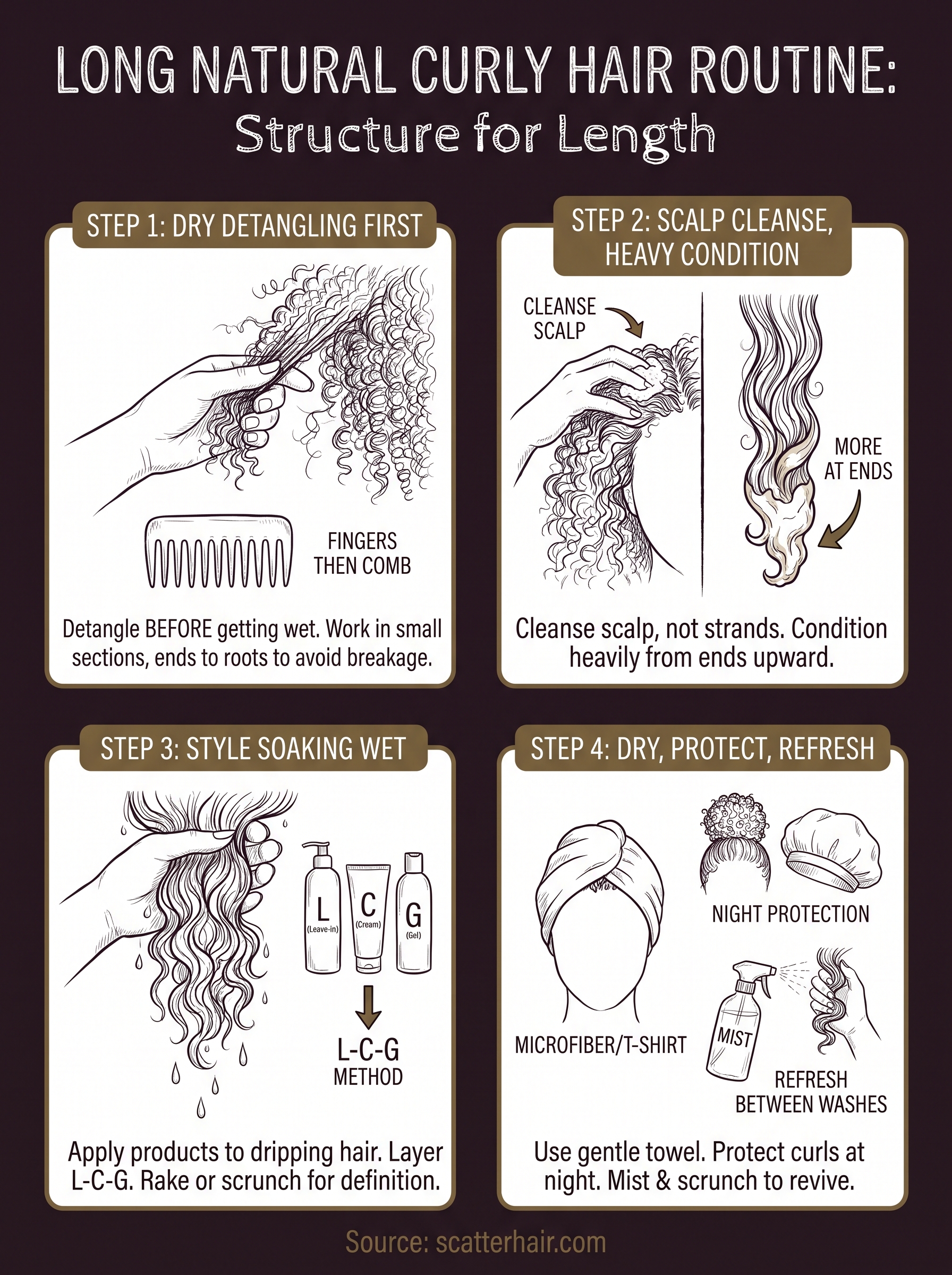
Most damage on long curly hair happens before the water ever touches it, during a rushed detangling session on wet, tangled strands. Wet curls stretch further than dry ones before they snap, so pulling a brush through soaking hair is the fastest way to lose length you spent years growing. A long natural curly hair routine steps approach starts dry, with fingers or a wide-tooth comb, working through the tangles your hair collected while you slept or wore it up all week.
Why dry detangling protects your length
Dry hair still has some natural oil coating the cuticle, which gives strands a little slip and cushions them against friction. Add water and conditioner too early, and the hair swells, the cuticle lifts, and every knot becomes a pull point instead of something that slides free. Detangling dry, section by section, means you're removing the bulk of the mats before your hair is in its most fragile state.
Detangle dry first, and you'll lose knots instead of length.
How to detangle long curly hair without breaking it
Work in small sections rather than attacking your whole head at once. This is where a natural hair curly routine actually saves you time, because small sections mean fewer breaks and less frustration halfway through.
- Split hair into four to six sections and clip the rest away.
- Apply a light detangling oil or slip spray to one section at a time.
- Start finger-detangling from the ends, working upward toward the roots.
- Switch to a wide-tooth comb only once fingers move through smoothly.
- Re-clip each finished section so it stays separate until wash time.
Going ends-first matters more on long hair than anywhere else, since that's where the oldest, most tangle-prone strands live. Skipping this step and heading straight into the shower is the single most common reason people feel like they're fighting their curls instead of working with them, and it's the easiest fix in this entire routine.
Step 2. Cleanse and condition with intention
Once your hair is detangled dry, cleansing becomes about targeting the scalp instead of scrubbing your whole head. Long curly hair doesn't need daily washing, and over-washing strips the little natural oil that made your dry detangling possible in the first place. A curly hair routine natural to your hair type usually means washing once or twice a week, focusing shampoo or a low-poo cleanser directly on the scalp where oil and product buildup actually collect, and letting the sudsy runoff rinse through the lengths on its way down.
Cleanse the scalp, not the strand
Section your hair the same way you did for detangling, then apply cleanser with your fingertips in small circular motions right at the roots. Skip the urge to pile shampoo onto your ends, since that's the part of your hair with the least oil to remove and the most damage risk from friction. Let the water and cleanser that trickle down during rinsing handle the mid-lengths and ends passively, which is usually all they need.
Condition like you mean it
Conditioner is where long hair earns its keep, and this is the step most people rush. Your ends are older, more porous, and drier than your roots, so they need a heavier hand with conditioner every single wash.
Your roots need less conditioner than you think, and your ends need more than you're using.
Work through these steps in order for a natural hair curly routine that actually holds moisture through a full week:
- Apply conditioner starting at your ends, working upward.
- Concentrate the heaviest layer on your last few inches.
- Use a wide-tooth comb to distribute conditioner evenly section by section.
- Let it sit for at least three to five minutes before rinsing.
- Rinse with cool water to help the cuticle lay flat.
This order matters because it treats your ends like the fragile, aged part of your hair they actually are, rather than an afterthought at the end of the shower. Getting cleansing and conditioning right here sets up everything that comes next, starting the moment you step out of the shower with soaking wet curls.
Step 3. Style while your curls are soaking wet
Styling products work best on saturated hair, not damp hair, because water is what carries the product into the curl and helps the pattern clump instead of frizz. Waiting until your hair is 80% air-dried before applying gel or cream is one of the most common mistakes in a long natural curly hair routine, since product sitting on top of dry cuticle just coats the surface instead of sealing moisture in. Apply everything while your curls are still dripping, and let the water do the work of pulling product through to the ends.
Layer products from thinnest to thickest
The order you apply products in matters as much as the products themselves. Start with a leave-in conditioner to reinforce the moisture your rinse-out conditioner just gave you, follow with a curl cream for definition, and finish with a gel or styling foam for hold. This layering, often called the LOC or LCG method, gives you a natural curly hair care routine that holds through humidity instead of falling apart by afternoon.

Apply product to soaking wet hair, not damp hair, or you're just coating dry strands instead of sealing them.
Scrunch or rake, but stay consistent
How you distribute product changes the final texture, so pick one method and stick with it for a full wash cycle before judging results.
- Rake product through with your fingers section by section for more definition and separation.
- Scrunch upward from the ends toward the scalp for tighter, bouncier clumps.
- Praying-hands smooth the front pieces if you want a sleeker part or edges.
- Avoid touching your hair again once it starts drying, since disturbing the curl mid-dry causes frizz.
Long hair holds more product weight before it looks weighed down, so don't be afraid to use more than you think you need, especially on the mid-lengths and ends where the last routine step left extra conditioner behind. This is also where an all natural curly hair routine either pays off or falls apart, since heavier, longer strands need real hold to fight gravity all the way down to the tips.
Step 4. Dry, protect, and refresh between washes
Drying is where a lot of long curly hair loses its shape, mostly because people rub with a bath towel or let curls hang loose under a fan. Microfiber towels or an old cotton t-shirt cut frizz dramatically compared to terry cloth, since the smooth surface doesn't rough up the cuticle the way regular towels do. Plopping, where you scrunch soaked hair up into the shirt and let it sit for ten to fifteen minutes, pulls excess water out without disturbing the clumps you just styled. This one swap is often the difference between a natural curly hair routine that looks fresh all week and one that frizzes out by hour three.
Protect your curls overnight
Sleeping on long curly hair undoes a surprising amount of the work you just put in, since cotton pillowcases pull moisture out and friction flattens curls against your head. Gather your hair loosely into a pineapple at the crown, or wrap it in a satin or silk bonnet, before you go to bed. Either method keeps the curl pattern intact and cuts down the tangling that would otherwise send you straight back to Step 1 the next morning.
Protect your curls at night, or you'll be detangling knots you created in your sleep.
Refresh without a full wash day
Long hair doesn't need reworking every day, but it does need small check-ins to stay looking styled between wash days. A quick refresh routine looks like this:
- Mist roots and mid-lengths with water or a diluted leave-in spray.
- Scrunch gently to reactivate clumping, focusing on flattened sections.
- Add a small amount of gel only where frizz has crept in.
- Re-pineapple or re-bonnet before bed to lock the refresh in.
Refreshing this way, rather than rewashing, keeps you from stripping the oils and product you worked to build up over the week. Combined with the earlier steps, this is what turns a one-time good hair day into an actual long natural curly hair routine you can repeat wash after wash.
Finding the rhythm that works for your curls
A long natural curly hair routine isn't a fixed recipe you follow forever. It's a rhythm: detangle dry, cleanse the scalp, condition the ends heavily, style soaking wet, then protect what you built until the next wash. Your hair will tell you when something's off, whether that's frizz creeping in by day two or curls hanging looser than usual, and each of those signals points back to one of the four steps above. Once you've run through this cycle a few times, adjusting product amounts and wash frequency to what your specific curls need, the guesswork disappears and you're left with a routine that actually holds up over the length of your hair, not despite it.
Getting the steps right matters, but so does what you're putting on your curls in the first place. If you want products built specifically for how textured hair actually behaves, see what Scatter is building before launch.