

What Is Co-Washing? Benefits, Drawbacks, And How To Do It
If you have textured hair, you've probably heard someone swear by co-washing at some point. Maybe a friend told you to ditch your shampoo entirely. Maybe you saw a tutorial that left you wondering if conditioner alone can really get the job done. It's a fair question, and the answer isn't as simple as yes or no.
Co-washing (short for conditioner-only washing) has become a go-to technique for people with curls, coils, and waves who want to cleanse without stripping their hair dry. But it's not a universal fix. It works brilliantly for some and falls flat for others, depending on your hair type, scalp condition, and styling routine.
At scatterhair, we're building styling products specifically for textured hair, products that perform without fighting your natural pattern. Understanding techniques like co-washing matters because how you cleanse directly affects how your hair holds a style. Below, we'll break down exactly what co-washing is, who it's best suited for, the real benefits and drawbacks, and how to do it step by step.
Why co-washing matters for textured hair
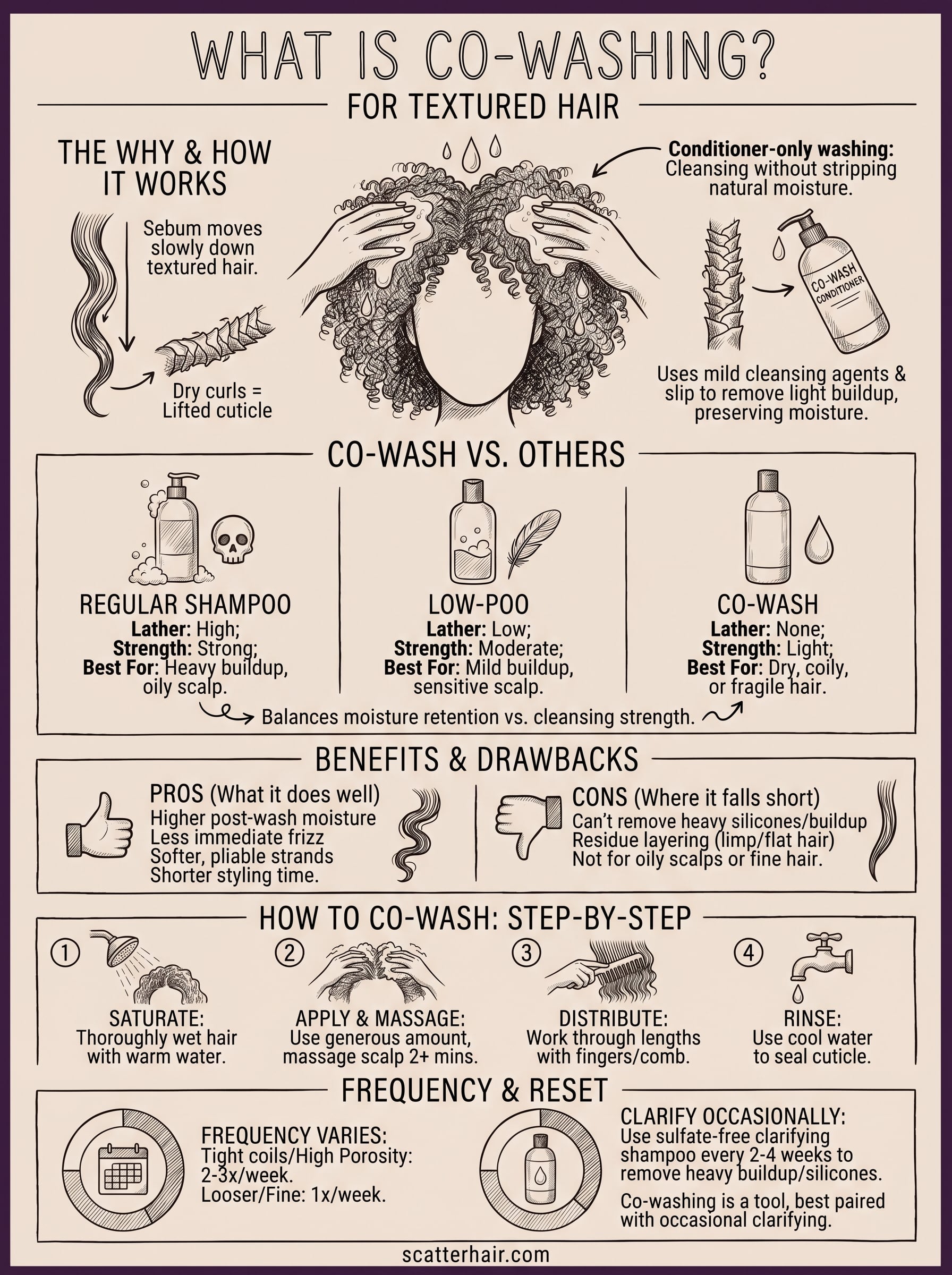
Textured hair, whether it's curly, coily, or wavy, has a fundamentally different structure than straight hair. The curl pattern creates natural bends and twists along each strand, which slow down the movement of sebum (your scalp's natural oil) from root to tip. That means textured hair tends to run drier than straight hair by default, and that built-in dryness is the core reason why your cleansing method matters so much.
The structure behind the curl
Each curl or coil has a raised cuticle layer running along the outside of the strand. When your hair is healthy and hydrated, those cuticle scales lie relatively flat and your curls look defined. When your hair loses moisture, those scales lift, the strand becomes rough and porous, and frizz takes over. Your natural curl pattern weakens, and styling stops working the way it should.
Understanding this helps explain what is co-washing and why it appeals specifically to people with textured hair. The goal isn't just to clean. It's to clean without triggering the dryness cycle that makes your hair harder to manage with every wash.
What shampoo actually does to your coils
Most conventional shampoos rely on sulfate-based surfactants to lift buildup and oil from your scalp and strands. Sulfates work, but they're not selective. They remove product residue and excess sebum while also pulling out the natural oils your hair needs to stay moisturized. For someone with straight hair, the scalp replenishes that oil quickly. For someone with tight curls or coils, those oils rarely travel far down the shaft to begin with.
The drier your hair starts, the less moisture it holds onto after you cleanse it.
That's where co-washing comes in. Using a conditioner with mild cleansing agents instead of a sulfate shampoo lets you remove light buildup without creating a moisture deficit, so your curls start styling day in a better position.
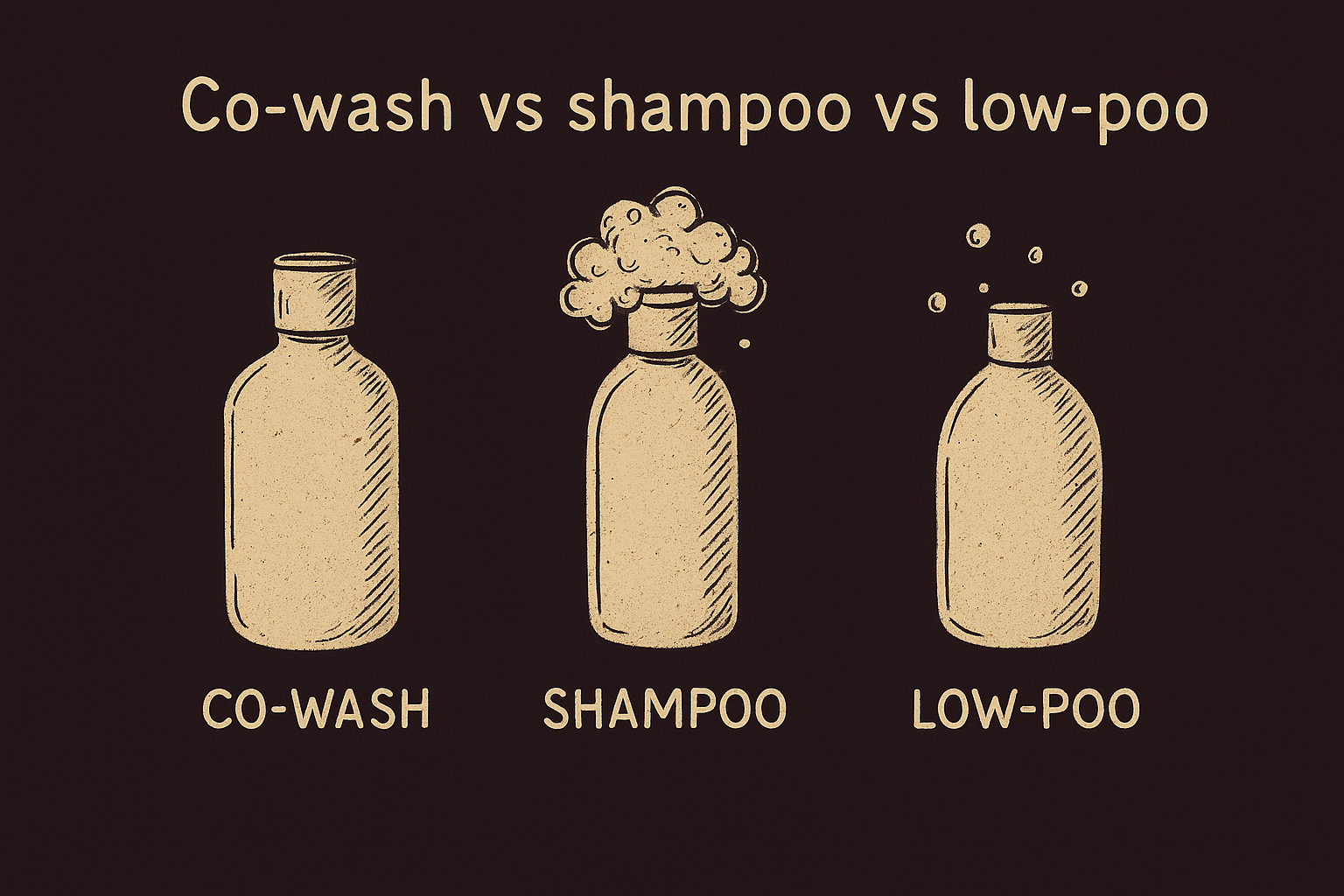
Co-wash vs shampoo vs low-poo
Not every cleansing method works the same way, and picking the right one comes down to your hair's needs and how much buildup you typically deal with. Understanding what is co-washing is easier when you see it side by side with a regular shampoo and the middle-ground option known as low-poo (short for low-lather shampoo).
What each method does differently
Regular shampoo typically contains sulfates, which produce a strong lather and strip away oil and product buildup aggressively. That level of cleansing is more than most textured hair needs on a weekly basis, and it often leaves your curls feeling rough and stripped after wash day.
Low-poo and co-washing both reduce the disruption to your hair's moisture balance, but they work through different mechanisms.
Low-poo shampoos use mild, sulfate-free surfactants that still lather lightly and clear buildup without the harsh drying effect of conventional shampoo. Co-washing skips surfactants almost entirely and relies on the emulsifying and slip properties of conditioner ingredients to lift dirt and light residue from your hair and scalp.
| Method | Lather | Cleansing Strength | Best For |
|---|---|---|---|
| Regular shampoo | High | Strong | Heavy buildup, oily scalp |
| Low-poo | Low | Moderate | Mild buildup, sensitive scalp |
| Co-wash | None | Light | Dry, coily, or fragile hair |
Benefits and drawbacks of co-washing
Understanding what is co-washing also means knowing when it works and when it doesn't. Co-washing delivers real results for certain hair types, but using it without understanding its limits can leave your curls worse off than when you started.
What co-washing does well
Co-washing keeps moisture levels higher after wash day because you're not stripping your hair with surfactants. For people with tight coils or low-porosity curls, that retained moisture means less time and fewer products just to get your hair back to a workable baseline.
The less you strip your hair, the less work your styling products have to do afterward.
- Less frizz immediately after washing
- Softer, more pliable strands between wash days
- Shorter styling time because your curls aren't starting dry
Where co-washing falls short
Co-washing has real limitations. Conditioner alone can't effectively remove heavy product buildup, silicones, or excess sebum from your scalp, so those things accumulate over time.
If you use leave-ins, butters, or oil-based stylers regularly, co-washing every session layers residue on top of residue until your curls feel weighed down and limp. People with fine-textured curls or oily scalps often notice their hair looks flat and greasy within a day of co-washing. That doesn't mean the technique is broken; it just means your hair needs a stronger cleanse more regularly than co-washing alone can provide.
How to co-wash your hair step by step
Knowing what is co-washing is one thing; actually doing it well is another. The process is simple, but a few specific steps separate a wash day that leaves your curls defined from one that just leaves them limp or sticky.
The process from start to finish
Start with thoroughly saturating your hair with warm water before applying any product. Dry hair won't absorb conditioner evenly, and you'll end up with patchy coverage that leaves some sections stripped and others overloaded.
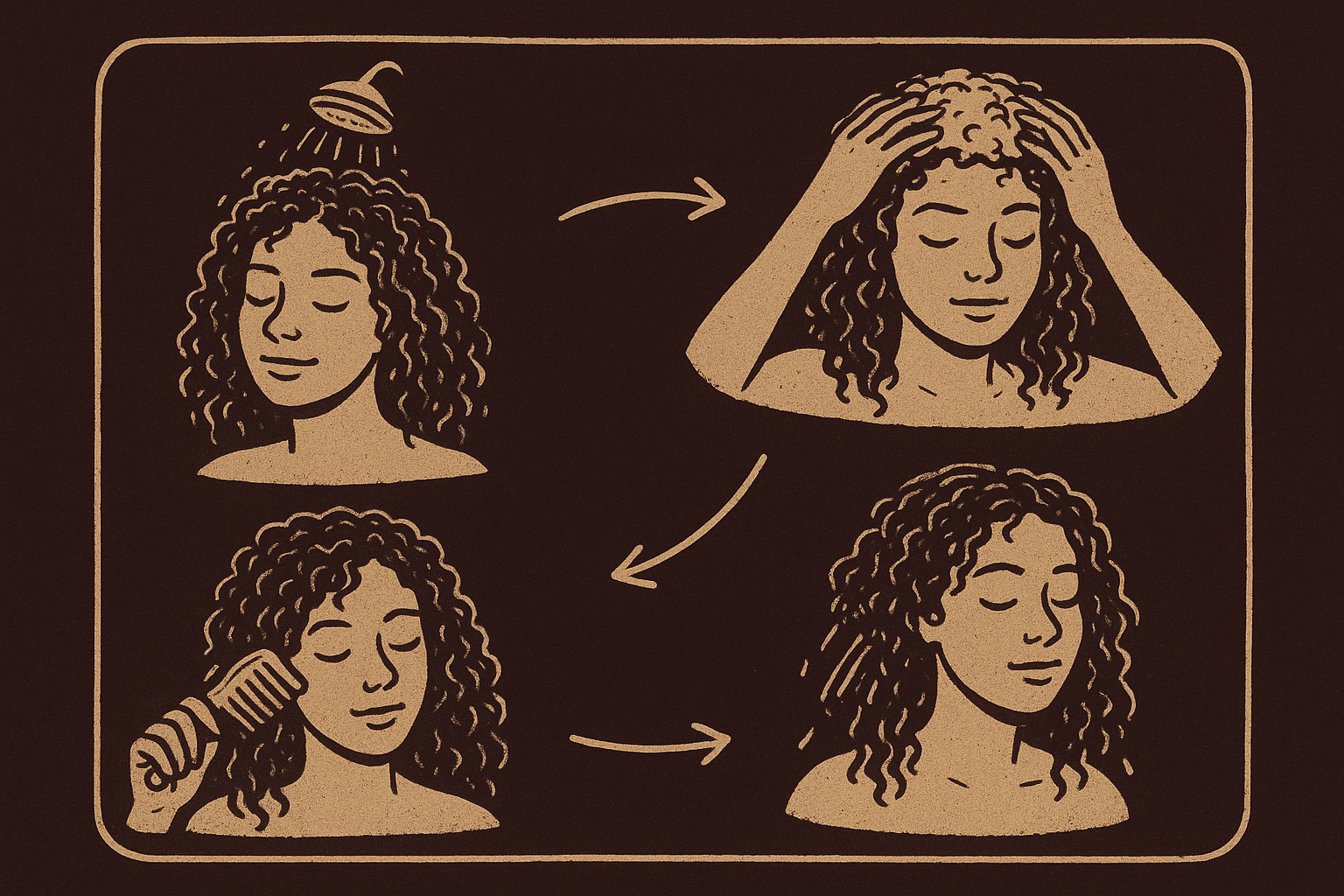
Skipping the saturation step is one of the most common reasons co-washing leaves curls feeling coated rather than clean.
- Apply a generous amount of co-wash conditioner in sections, working from roots to ends
- Use your fingertips to massage your scalp in small circular motions for at least two minutes
- Distribute the product through your lengths with a wide-tooth comb or your fingers
- Rinse with cool water to help seal the cuticle down
Getting the most out of each wash
Pick a conditioner formulated without heavy silicones if you plan to co-wash regularly, since silicones accumulate fast without a surfactant to clear them out.
After rinsing, apply your leave-in or styler immediately while your hair is still soaking wet to lock in the moisture you just worked to preserve.
How often to co-wash and when to clarify
Once you understand what is co-washing and how to do it, the next practical question is frequency. The answer depends on your hair's porosity, density, and the styling products you use between wash days. There's no single schedule that works for everyone.
Finding your co-wash frequency
Most people with tight coils or high-porosity hair do well co-washing two to three times per week. If your curls feel dry and rough by day two, washing more frequently helps. People with looser curl patterns or fine strands often need only one co-wash per week before buildup becomes noticeable.
The moment your scalp feels itchy or your curls look dull and heavy, you've pushed your co-wash schedule too far.
When to reach for a clarifying shampoo
Co-washing alone cannot remove silicones, wax-based products, or heavy oil buildup from your strands and scalp. If your curls feel limp, coated, or just off after washing, that's your signal to clarify. Use a sulfate-free clarifying shampoo every two to four weeks to reset your hair before returning to your regular co-wash routine.
- Limp, weighed-down curls that won't hold definition
- Product residue that rinse water won't budge
- Scalp itchiness or flaking despite regular washing
Final thoughts
Now that you understand what is co-washing and how it fits into a textured hair routine, the main takeaway is this: it's a tool, not a total replacement. Co-washing works best when you pair it with occasional clarifying sessions and styling products that don't create heavy buildup between washes. Your curl pattern, porosity, and scalp behavior all determine how often it makes sense for you.
Getting your wash day right is only part of the equation. What you put on your hair after matters just as much, and that's where the right styling products make or break your results. If you've been searching for formulas built specifically around textured hair performance, we're working on exactly that. Sign up at scatterhair.com to get early access and updates before the official launch. Your curls deserve products that actually work with them.