

Hair Shrinkage: What It Is and Why Your Curls Do It
You wash your hair, watch it stretch to your waist, and by the time it dries it barely grazes your shoulders. That's hair shrinkage, and if you've got curly or coily hair, you already know the feeling of wondering where the rest of your length went. It's one of the most confusing parts of having textured hair, especially when nobody explains what's actually happening beneath the surface.
Here's the short answer: shrinkage happens because your curl pattern coils and bends as it dries, pulling the strand inward like a spring. The tighter your curl, the more dramatic the pull, and in most cases, significant shrinkage is a sign of healthy, well-hydrated curls, not damage. Shrinkage that seems extreme or feels stiff and dry is a different story, and that's worth paying attention to.
In this article, we'll break down exactly why shrinkage happens, how to tell healthy shrinkage from the kind linked to damage, and what actually works to manage or reduce it when you want more length showing. If you're building a styling routine around your texture, understanding shrinkage is the first step.
Why hair shrinkage happens in curly and coily hair
Every strand of curly or coily hair grows out of a follicle that's shaped like an oval or a corkscrew instead of a straight tube. That shape forces the hair to grow in a spiral rather than a straight line, so as it dries, it naturally coils back on itself like a spring losing tension. Hair shrinkage is really just physics acting on that spiral: water swells the strand while it's wet, and as the water evaporates, the coil contracts and pulls the length up and in. Straight hair doesn't do this because there's no coil to contract, which is exactly why shrinkage reads as a curly-hair phenomenon rather than a universal one.
The role of hydrogen bonds
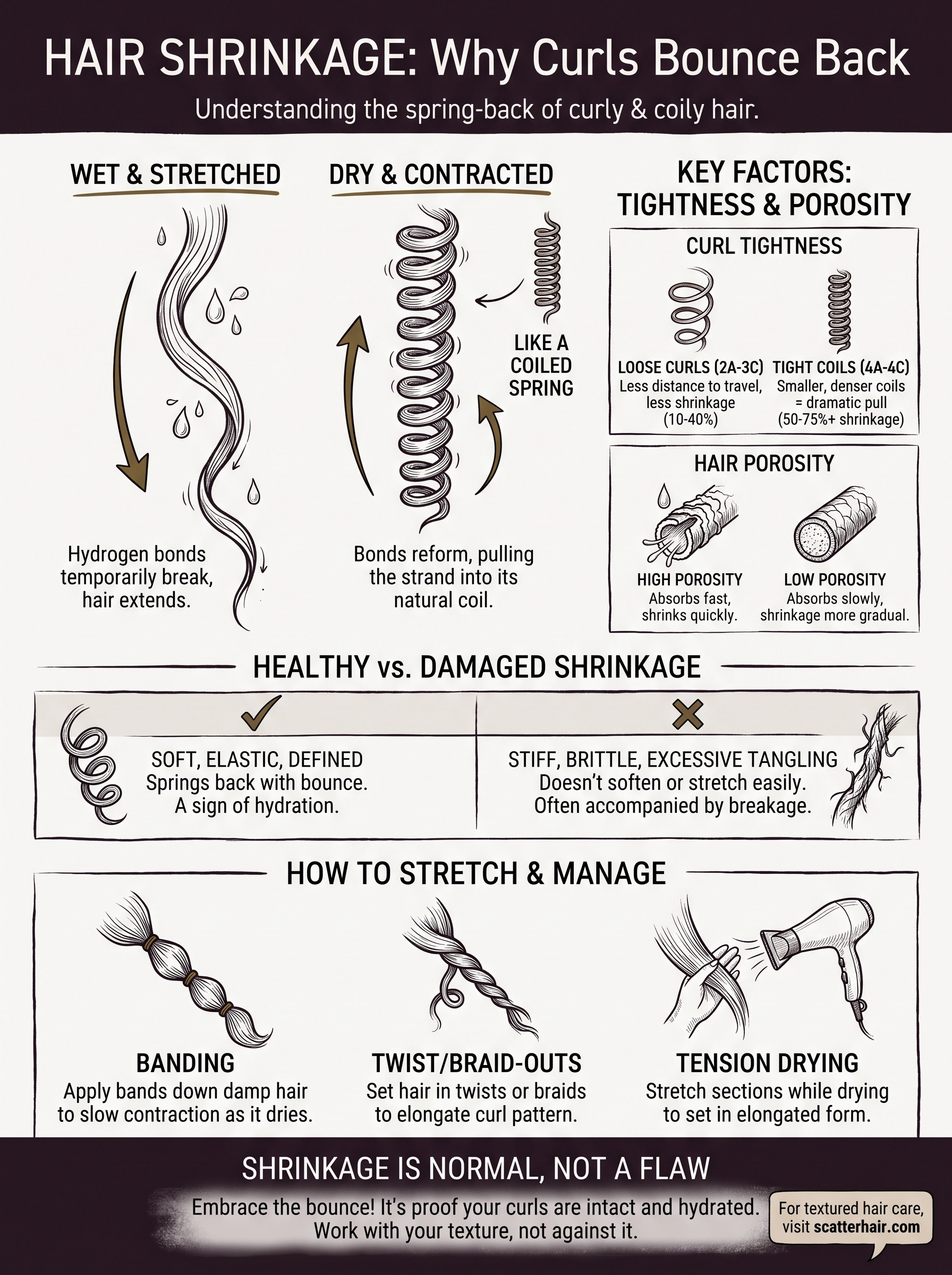
Inside every strand, hydrogen bonds hold the protein structure in a specific shape. When water enters the hair, it temporarily breaks those bonds, letting the strand stretch and relax. As the hair dries and the bonds reform, they lock the strand back into its natural curl pattern, and the tighter that pattern, the more forceful the pull. This is the same mechanism behind a wet-to-dry stretch you might have noticed yourself: hair that reaches past your shoulders when soaking wet can spring up several inches once it's fully dry.
Shrinkage is your curl pattern doing exactly what it's built to do, not a sign that something's wrong.
Porosity and curl tightness both matter
Two main factors determine how much any individual head of hair shrinks: curl pattern tightness and hair porosity. Tighter curl types, like 4A through 4C on the standard curl typing scale, tend to shrink the most because their coils are smaller and denser, sometimes shrinking 50% or more from wet to dry. Looser curls and waves shrink less dramatically because the spiral is wider and the pull has less distance to travel. Porosity plays a supporting role because it affects how much water the strand absorbs in the first place, and more absorbed water generally means a bigger swing between wet and dry length.
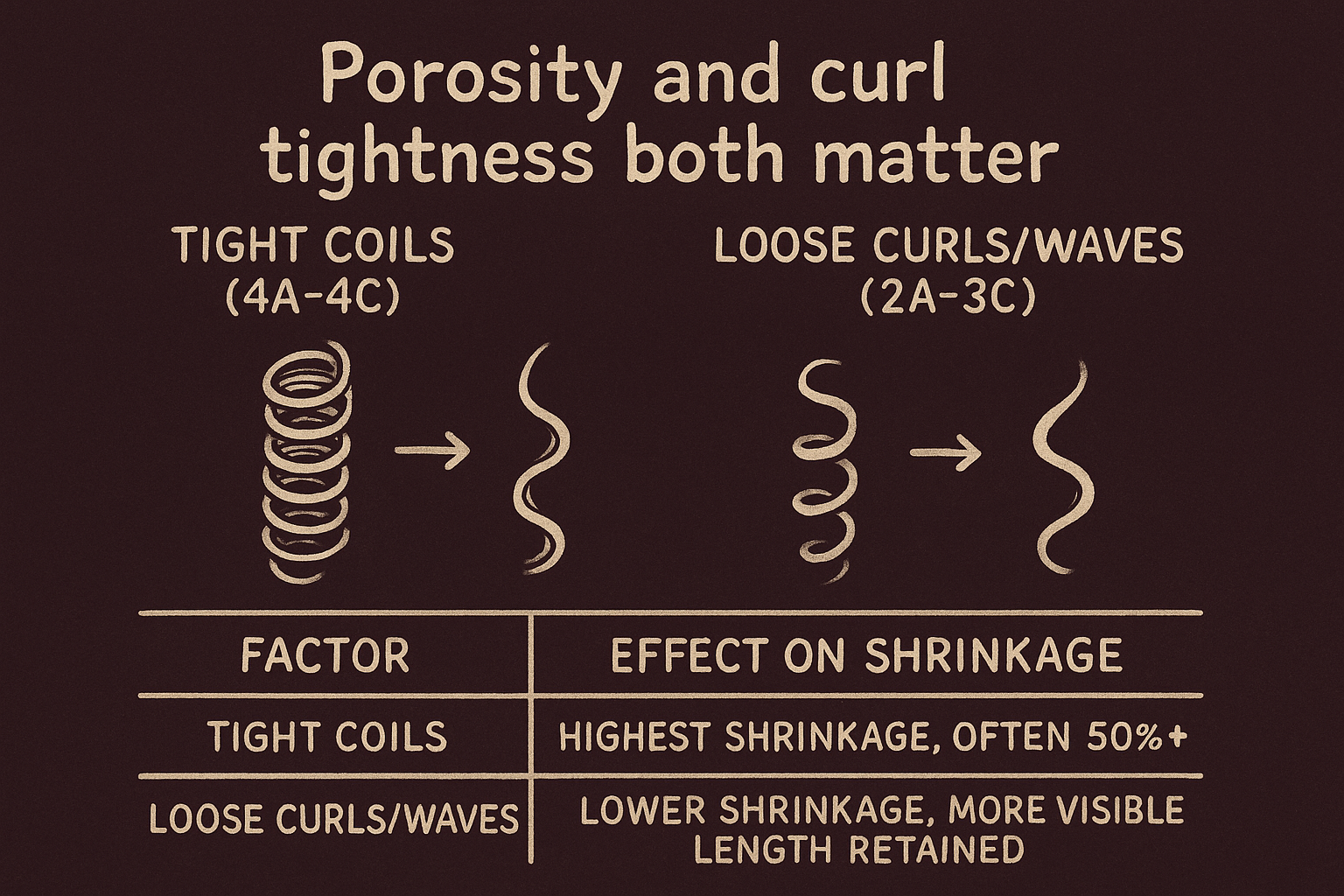
| Factor | Effect on shrinkage |
|---|---|
| Tight coils (4A-4C) | Highest shrinkage, often 50%+ |
| Loose curls/waves (2A-3C) | Lower shrinkage, more visible length retained |
| High porosity | Absorbs water fast, can shrink quickly |
| Low porosity | Absorbs slowly, shrinkage may be more gradual |
| Product buildup or dryness | Can exaggerate shrinkage and stiffness |
Think of your curl as a coiled phone cord. Stretch it out and it's long and loose. Let it relax and it snaps back into tight loops. Your hair is doing the same thing every time it dries, and the tighter the original coil, the more dramatic that snap-back looks.
When shrinkage signals a problem instead of health
Most shrinkage is a good sign, but it's worth knowing the difference between healthy contraction and shrinkage tied to damage. Healthy shrinkage feels soft, springs back with elasticity, and comes paired with defined, bouncy curls. Damage-related shrinkage often feels stiff, brittle, or accompanied by excessive breakage, tangling, or a rough texture that doesn't soften even after moisturizing. If your curls seem to shrink up tight and refuse to stretch back out with water or product, or if you're noticing more strands in your brush than usual, that's a cue to check your routine rather than assume it's just your natural pattern at work.
How to stretch your curls and reduce shrinkage
Wanting to see more length isn't about fighting your curl pattern, it's about working with it using the right techniques. Stretching your curls temporarily loosens the coil without permanently altering its structure, so you get more visible length while keeping your natural texture intact underneath. None of these methods change how your hair grows, they just slow down or interrupt the contraction that happens as your strands dry.
Stretching techniques that actually work
The most reliable methods rely on tension, whether that's from your hands, a tool, or the weight of the style itself. Here's what tends to work best for textured hair:
- Banding: Section damp hair and wrap small hair ties down the length at intervals, similar to a ponytail holder stacked repeatedly. As it dries, the tension keeps the coil from snapping back fully.
- The tension blow-dry method: Use a comb attachment or your fingers to stretch each section while directing airflow down the strand, elongating the curl as it dries instead of letting it dry loose and contract.
- Braid-outs and twist-outs: Braiding or twisting damp hair and letting it dry fully before unraveling gives you stretched definition with minimal manipulation.
- Roller sets: Wrapping sections around flexi-rods or perm rods stretches the hair while it sets, producing elongated curls once dry.
The goal isn't to erase your curl pattern, it's to slow down the spring-back long enough to show off your length.
Products and habits that support length retention
Moisture is the foundation of any stretching routine, since dry, brittle strands shrink up tighter and resist elongation. Leave-in conditioners and lightweight creams keep the strand pliable enough to hold a stretch, while heavier butters or gels can weigh curls down in a way that actually helps with elongation on thicker coils. Detangling before you dry, rather than after, also reduces the tension that pulls curls into tighter shrinkage once they're fully set.
Sleeping on a low-manipulation style, like a loose braid or pineapple, protects the stretch you've already achieved instead of letting friction undo it overnight. Combine that with regular deep conditioning, since well-hydrated hair holds elongation more easily than hair that's dry or overworked. None of these habits stop shrinkage completely, and that's fine, the point is giving yourself options for how much length shows on a given day.
Shrinkage by curl type: what to expect
Not every curl pattern shrinks the same amount, and knowing your own baseline saves you from panicking over normal behavior. Curl type gives you a rough guide for what to expect, though porosity, density, and product choice will always shift the numbers a little for your specific head of hair.
Waves and looser curls (2A-3C)
Wavy and looser curly types usually see the mildest shrinkage, often somewhere between 10% and 30% of wet length. Because the spiral is wider and the bends are fewer, there's simply less coil to contract as the strand dries. Someone with 2C or 3A hair might notice their length barely changes from wash day to dry day, which is why shrinkage rarely comes up as a concern in these looser patterns.
Coils and kinks (4A-4C)
Tighter coil types carry the most dramatic shrinkage, frequently landing between 50% and 75% depending on how tightly the strand curls at the root. 4C hair in particular can look like it barely grew at all once fully dry, even when the actual strand length is well past shoulder length when stretched. This is normal, not a sign that your hair isn't growing or that something's gone wrong with your regimen.
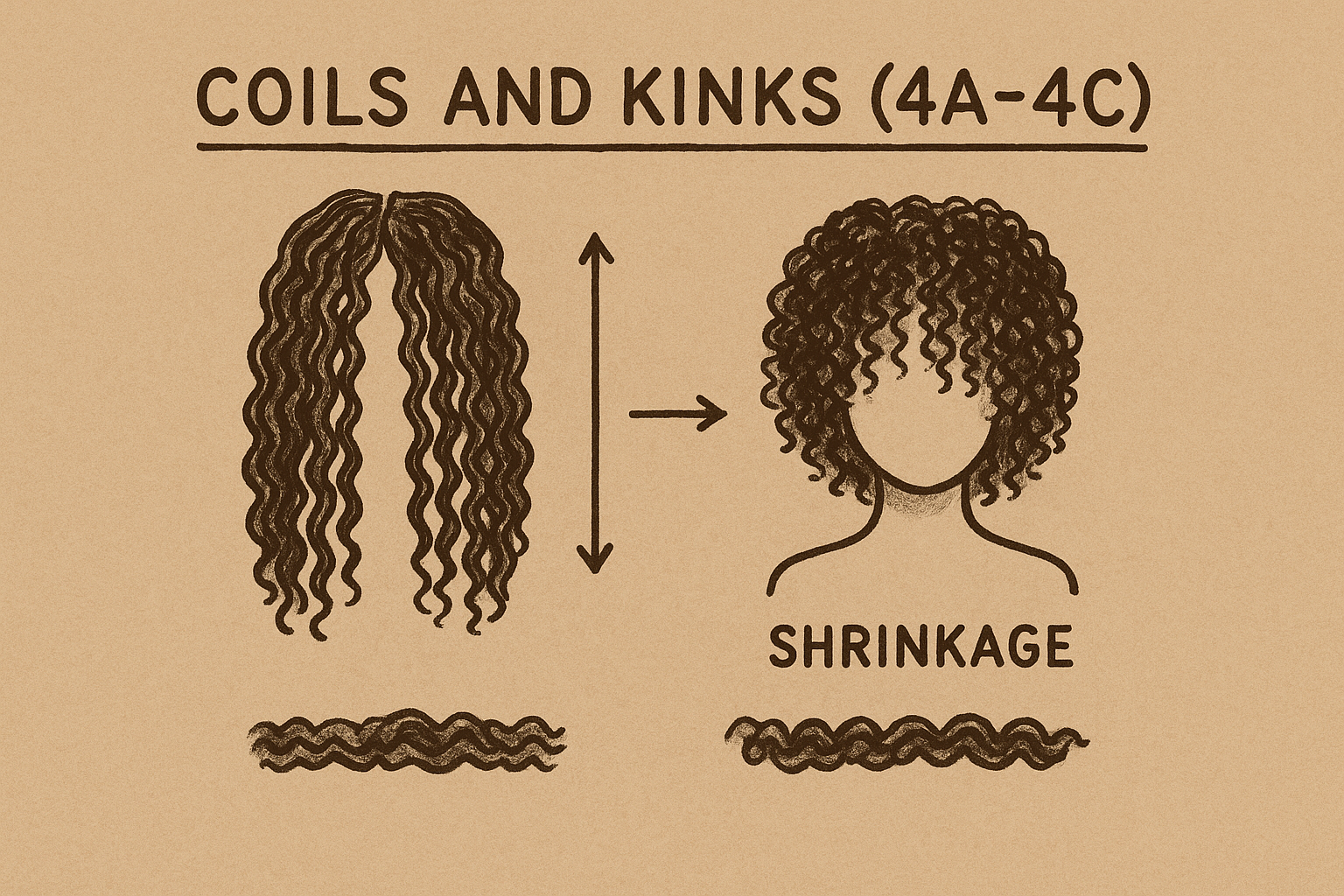
The tighter the coil, the bigger the gap between your wet length and your dry length, and that gap is expected, not alarming.
| Curl type | Typical shrinkage | What it looks like day to day |
|---|---|---|
| 2A-2C (wavy) | 10-20% | Minimal length change, waves loosen slightly when dry |
| 3A-3B (curly) | 20-40% | Noticeable spring-up, curls stay defined and springy |
| 3C-4A (curly/coily) | 40-60% | Significant bounce-back, length can look dramatically shorter |
| 4B-4C (coily/kinky) | 50-75% | Most dramatic shrinkage, hair may look half its stretched length |
Knowing where your curl pattern falls on this range helps you set realistic expectations instead of comparing your shrinkage to someone with a completely different texture. It also makes it easier to spot when something's off, since a sudden jump in shrinkage beyond your usual range is worth investigating rather than ignoring.
Making peace with your curls' natural bounce
Shrinkage isn't a flaw to fix, it's proof your curls are doing their job. Hair shrinkage tells you your strands are hydrated and your coil pattern is intact, and once you understand the mechanics behind it, that dramatic wet-to-dry change stops feeling like a mystery. Stretch your curls when you want more length on display, and let them coil up tight when you don't. Either way, you're working with your texture instead of against it.
Getting comfortable with your own shrinkage range means fewer bad hair days and a lot less frustration at the mirror. Your natural bounce is part of what makes textured hair distinctive, and the right products make it easier to style, whichever way you're wearing it. If you're ready for formulas built specifically for textured hair's real behavior, join the Scatter community and get early access when we launch.