

Andre Walker Hair Typing System: Types 1–4, Pros & Cons
If you've ever Googled your curl pattern, you've almost certainly run into the Andre Walker hair typing system. It's the classification method that sorts all hair into Types 1 through 4, from pin-straight to tightly coiled, with subcategories (A, B, C) layered on top. It's everywhere, product labels, beauty blogs, salon consultations.
At scatterhair, we build styling products specifically for textured hair, so we think about hair classification a lot. Understanding your type can be a solid starting point for choosing products that actually perform. But the system also has real limitations, and ignoring those can lead you down the wrong path when building a routine.
This article breaks down how the Andre Walker system works, where it came from, what each type looks like, and where the model falls short. By the end, you'll know how to place your own hair on the chart, and more importantly, you'll understand why that number doesn't tell the whole story.
What the Andre Walker hair typing system is
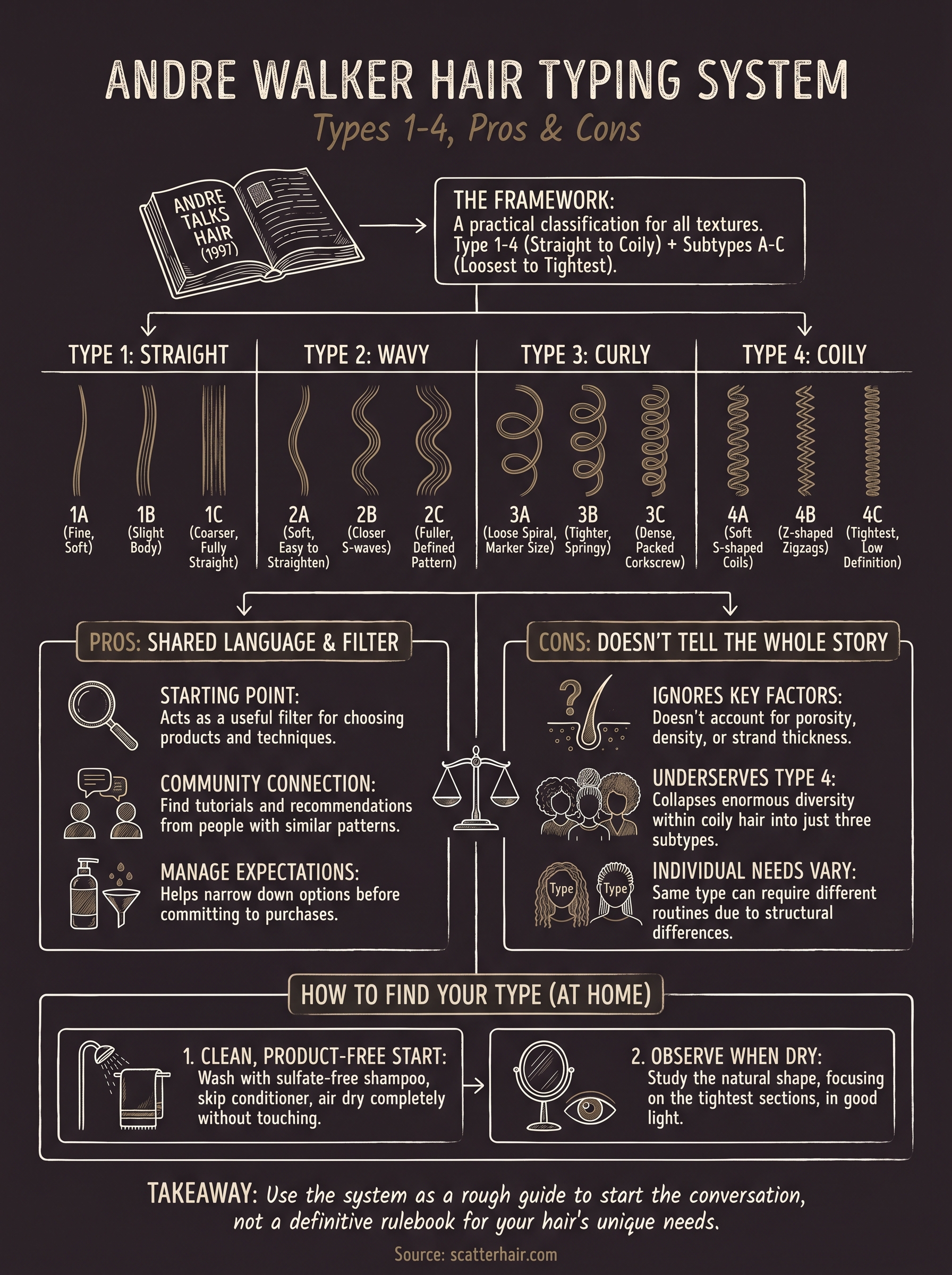
The Andre Walker hair typing system is a classification framework that divides all hair textures into four numbered categories: Type 1 (straight), Type 2 (wavy), Type 3 (curly), and Type 4 (coily or kinky). Each type is further divided into three subcategories, A, B, and C, which describe how loose or tight the pattern is within that group. The system gives people a quick shorthand for describing their hair and helps narrow down which products or techniques might actually work for them.
The man behind the system
Andre Walker is a celebrity hairstylist best known for his long-running work with Oprah Winfrey. He introduced the typing system in his 1997 book "Andre Talks Hair", which became a widely read hair care guide. Walker developed the chart as a practical tool to help everyday people identify their hair pattern and find appropriate products. Because of his public profile, the system spread quickly through salons, beauty stores, and eventually the internet, where it became the default language most people use when discussing curl patterns.
The system was not designed as a scientific framework. It was a practical guide created by one stylist, based on his own experience and client base.
How the chart is structured
The chart runs from Type 1A (fine, completely straight hair) at one end to Type 4C (tightly coiled hair with very little visible curl definition) at the other. Within each number, the A subcategory describes the loosest version of that pattern, B sits in the middle, and C describes the tightest. A Type 3A curl is a loose, large spiral, while a Type 3C curl is a tight, dense corkscrew. The labels give you a common vocabulary, which is genuinely useful when reading product descriptions or watching styling tutorials online.
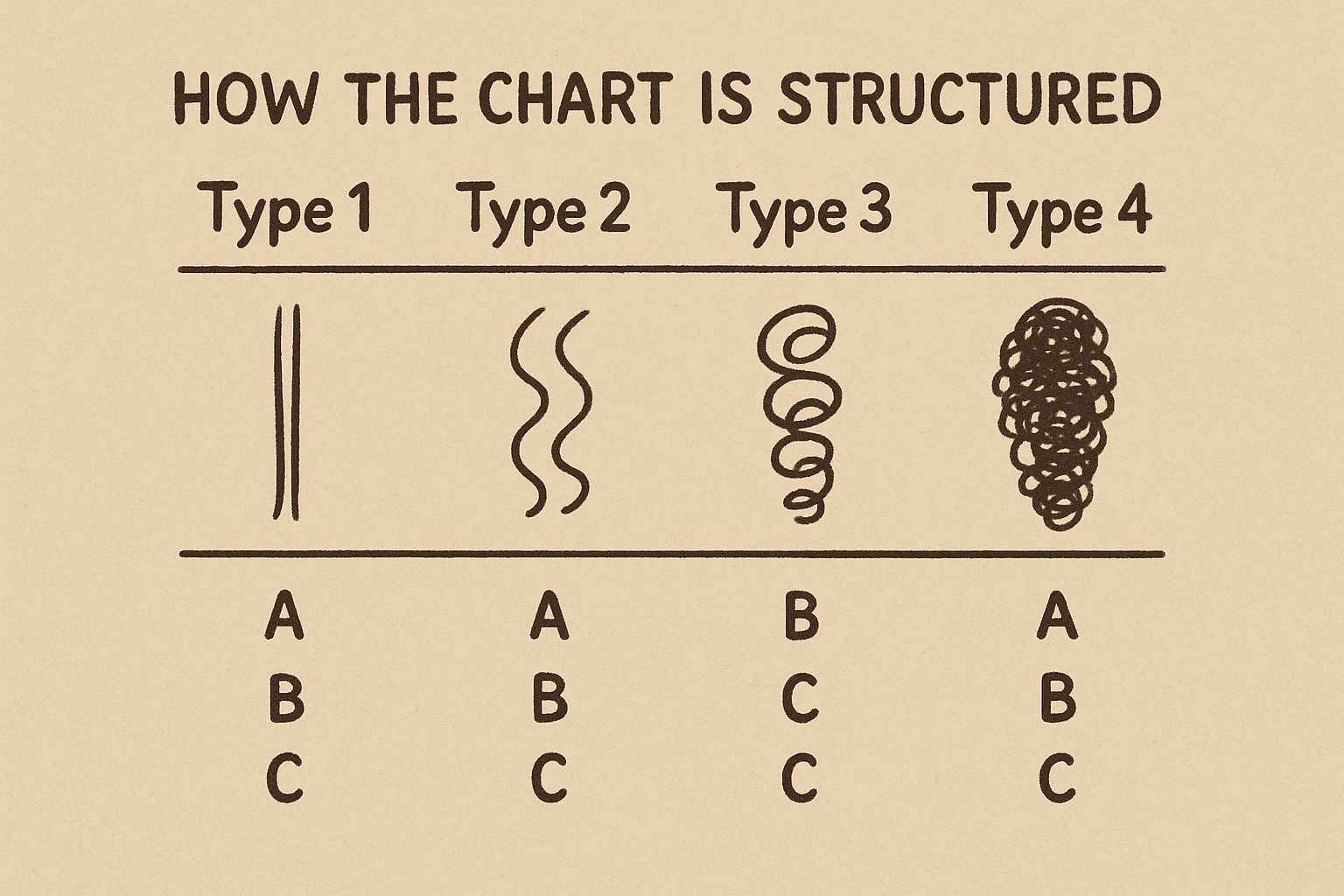
Most people find they sit somewhere between two subtypes rather than landing cleanly in one box. Your hair can also behave differently depending on length, moisture levels, and how you handle it after washing. That's one of the first things worth keeping in mind before you take the system too literally.
Why hair typing still matters
Despite its limitations, the andre walker hair typing system still gives you something valuable: a shared language. When a product label says it's designed for Type 4 coils, you immediately have a rough sense of whether it's meant for your hair or not. That context matters, especially when you're sorting through hundreds of options online, in a store, or trying to follow a tutorial that assumes you already know your pattern.
It helps you filter products faster
Your hair type acts as a useful starting filter when reading product descriptions or following styling tutorials. If a stylist demonstrates a technique on Type 3B curls and yours sit tightly coiled at 4C, you can adjust your expectations before buying anything. Mismatched product choices often come from skipping this step entirely. Without any classification system at all, product selection becomes a guessing game with no real starting point.
Knowing your type won't guarantee a product works, but it narrows the field significantly before you commit to anything.
It connects you to a wider community
One underrated benefit of the typing system is that it connects you to other people with similar patterns. When you search for tutorials or join online hair communities, your type becomes an effective search filter. You can find routines, product recommendations, and styling techniques from people whose hair actually behaves like yours. That kind of comparison is genuinely harder to do without a shared vocabulary, however imperfect that vocabulary turns out to be. The system gives a common reference point that makes those conversations much easier to start.
How to find your hair type at home
Finding your place on the andre walker hair typing system chart is straightforward, but you need to start from a reliable baseline. Most people assess their hair type when it's loaded with product or styled, which gives you a skewed result. To get an accurate read, you need clean, air-dried hair with nothing in it.
Start with clean, product-free hair
Wash your hair with a gentle, sulfate-free shampoo and skip the conditioner just this once. You want to see your natural pattern without any added weight or slip from conditioning agents. Then let it air dry completely, without touching it or scrunching it. Hands-off drying gives you the closest look at your true texture and how your hair naturally behaves on its own.
Applying product before you identify your type means you're reading the product, not your hair.
Look at your pattern once it's fully dry
Once your hair is completely dry, stand near a mirror in good lighting and study the shape your strands form. Straight strands with no bend at all point toward Type 1. A loose S-wave suggests Type 2. Defined spiral or corkscrew curls land in Type 3. If your hair forms tight coils or zigzag patterns with very little visible curl definition, you're likely in the Type 4 range. Pay attention to the tightest sections of your hair, not the loosest, since damage and length can loosen your pattern and shift your read toward a lower type.
Types 1–4 and subtypes A–C explained
The andre walker hair typing system covers twelve distinct subtypes across four main categories. Each number describes a broad texture family, and each letter refines that further by tightness of the pattern. Here's how each group breaks down so you can place yourself accurately.
Types 1 and 2: straight and wavy
Type 1 hair lies completely flat with no curve at all. Type 1A is fine and soft, 1B has slightly more body, and 1C is coarser but still fully straight. Type 2 hair forms a loose S-wave. Type 2A waves are soft and easy to straighten, 2B waves sit closer to the head, and 2C waves are fuller with some frizz and a more defined pattern.
The difference between 1C and 2A is subtle. When in doubt, check whether your hair forms any wave at all when dry.
Types 3 and 4: curly and coily
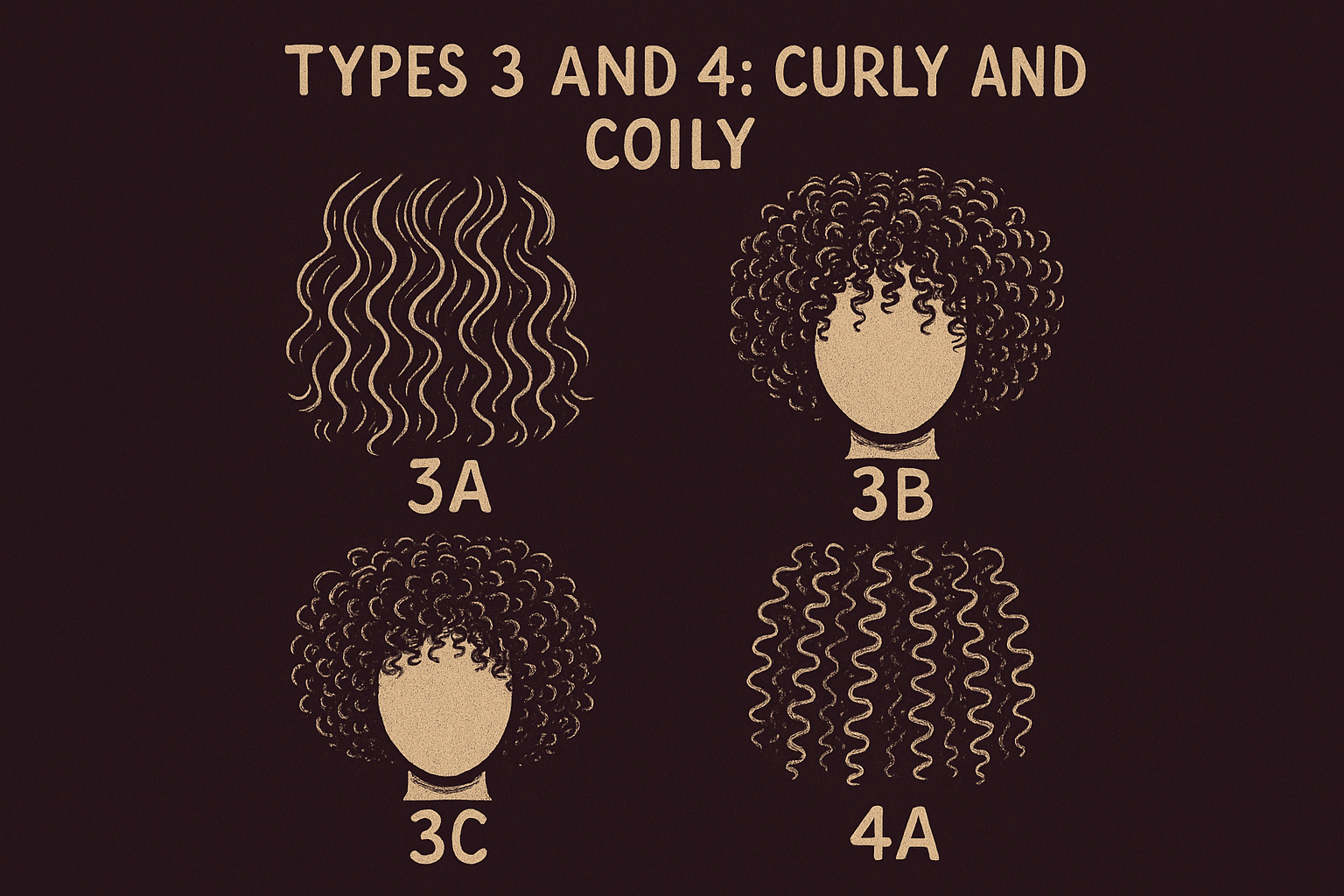
Type 3 hair forms clear spirals or corkscrews. Type 3A curls are loose and wide, roughly the size of a large marker. Type 3B curls are tighter and spring up more noticeably. Type 3C curls are dense, packed tight, and have significant volume. Type 4 hair is coily and ranges from soft S-shaped coils (4A) to Z-shaped zigzag patterns (4B) to 4C, which has the tightest coil structure and often shows very little visible curl definition without product or moisture added.
Pros, cons, and common criticisms
The andre walker hair typing system works well as an introduction to hair texture, but it has real gaps that matter more the deeper you go into your own routine. Understanding both sides helps you use the system as the blunt instrument it actually is, rather than a precise diagnostic tool.
What the system gets right
The biggest strength of the system is its accessibility and reach. Most people can identify their general type in minutes, and because the chart became so widespread, product developers and tutorial creators adopted the same language. That alignment gives you an immediate practical shortcut when reading reviews, following routines, or shopping for products. For beginners especially, having any starting point is better than none.
The system's real value is in giving you a common reference, not a complete picture of your hair's needs.
Where it falls short
Critics, particularly those in the natural hair community, point out that the system underserves Type 4 hair by collapsing enormous variation into just three subtypes. There is far more diversity within Type 4 than within Types 1 or 2 combined, yet the chart treats them with equal weight. The system also ignores porosity, density, strand thickness, and scalp health, all of which affect how your hair actually responds to products. Two people with the same listed type can have completely different routines because their hair's underlying structure differs. Type alone cannot predict what your hair needs, which is the most important limitation to carry with you when using this chart.
Quick recap
The andre walker hair typing system gives you a practical starting point for understanding your hair, but it works best when you treat it as a rough guide rather than a rulebook. Types 1 through 4, with their A, B, and C subcategories, describe curl pattern only. They say nothing about your hair's porosity, density, or strand thickness, all of which shape how products actually perform on your hair.
Your type helps you filter products and find relevant tutorials, and it connects you with people who share your pattern. But two people with the same listed type can need completely different routines based on factors the chart never accounts for. Use the system to start the conversation with your hair, not to end it.
If you have textured hair and want products built around real performance rather than marketing promises, explore what Scatter is building ahead of the 2026 launch.