

Curl Pattern Chart: Find Your Curl Type In 60 Seconds
You've probably seen a curl pattern chart floating around Instagram or Pinterest, a grid of hair types labeled 1A through 4C, and thought, cool, but which one am I? You're not alone. Most people with textured hair have stared at these charts and walked away more confused than when they started. The categories blend together, the descriptions feel vague, and your hair never looks exactly like the example photos.
Here's the thing: knowing your curl type isn't just a fun fact. It directly affects which products, techniques, and routines will actually work for you, and which ones are a waste of your time and money. That's exactly why we built scatterhair around performance-driven styling products for textured hair. Every formula we develop starts with understanding how different curl patterns behave, move, and hold shape. So yeah, we think about this stuff constantly.
This guide breaks down every curl type on the chart, shows you how to identify yours in about 60 seconds, and explains what that means for your styling routine. No guesswork, no squinting at blurry comparison photos. Just a clear, practical system you can actually use.
What a curl pattern chart is and isn't
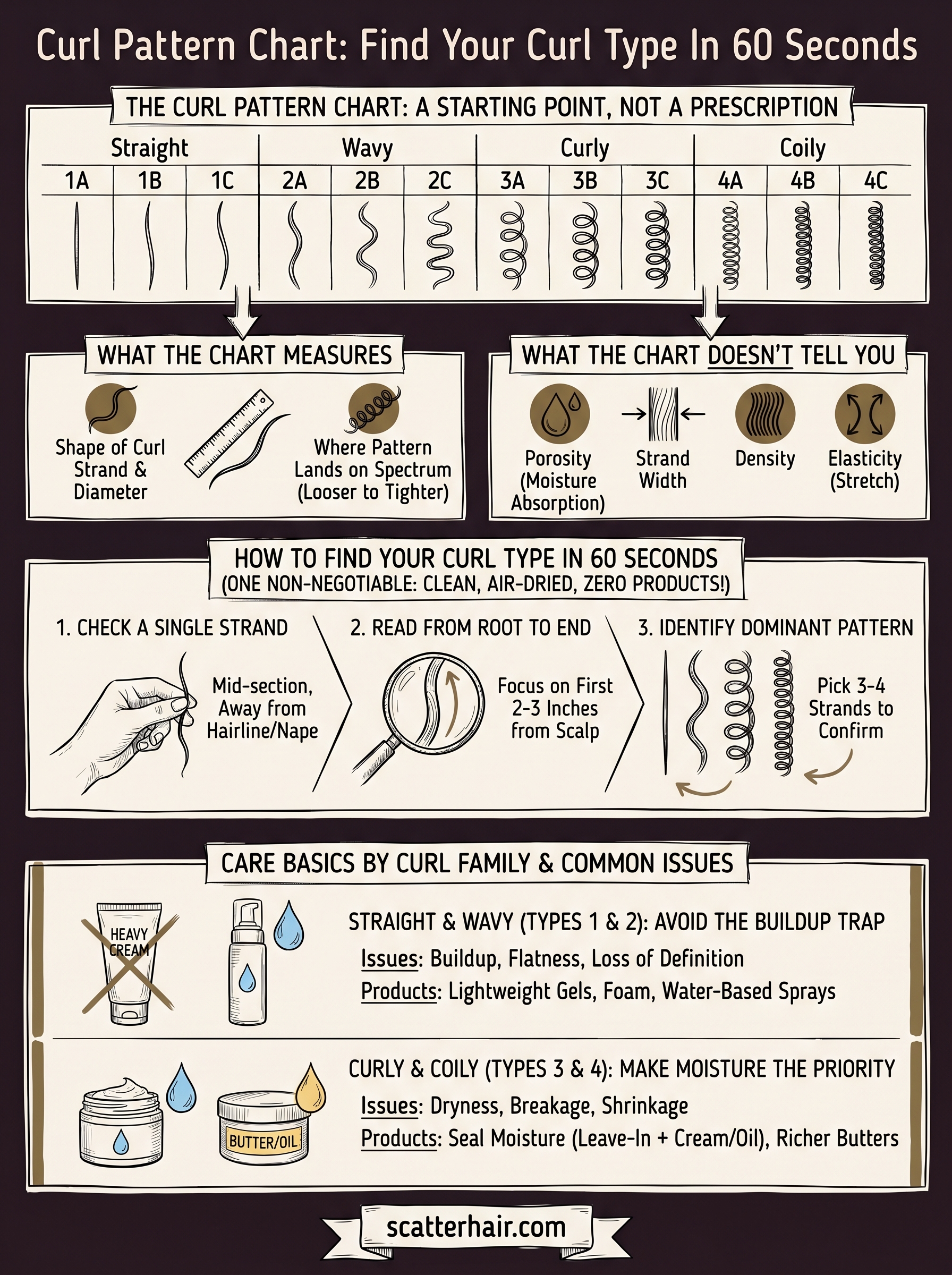
A curl pattern chart is a classification system that organizes hair into four numbered categories based on how each strand naturally bends, coils, or lies flat. Each number (1 through 4) represents a broad hair family, and each letter (A, B, or C) describes how tight or loose the pattern is within that family. The system was popularized by hairstylist Andre Walker in the 1990s and has since been expanded and widely adopted across the textured hair community. Think of it as a shared language for describing what your hair naturally does when it's clean, dry, and completely free from styling products.
The chart gives you a starting point, not a complete picture of your hair.
What the chart actually measures
The chart classifies hair based on the shape of the curl strand and the diameter of the bend. A 1A is completely straight with zero wave. A 2A has a soft, barely visible wave. By the time you reach 4C, you're looking at tight, densely packed coils that can shrink by more than 75% after washing. Each letter within a number category tells you where your pattern lands on the spectrum from looser to tighter. Here's a quick reference:
| Type | Description | Pattern Shape |
|---|---|---|
| 1A-1C | Straight | No bend at all |
| 2A-2C | Wavy | Soft S-wave |
| 3A-3C | Curly | Spiral or defined ringlet |
| 4A-4C | Coily | Tight coil or sharp zig-zag |
Most people with textured hair fall somewhere in types 2 through 4. It's also extremely common to have more than one pattern on your head at the same time, particularly around the hairline, crown, and nape, where texture often shifts noticeably.
What the chart doesn't tell you
Here's where most people get misled. The chart tells you the shape of your curl. It does not tell you how your hair absorbs moisture, how thick each individual strand is, how much hair you actually have on your head, or how stretchy your strands are under tension. These factors, specifically porosity, strand width, density, and elasticity, play a massive role in how your hair responds to products and heat and styling techniques.
Two people can share the exact same curl type and need completely different products because one has high porosity with fine strands and the other has low porosity with coarse, thick strands. If you've ever followed a routine designed for your curl type and gotten terrible results, this is almost certainly why.
Your curl pattern is one data point in a larger profile. Using it alone to select products is like choosing a running shoe based only on foot length without checking width or arch support. It gets you in the right ballpark, but the details matter. The chart works best when you treat it as a first filter, a way to narrow down your starting point before you factor in everything else that makes your hair unique.
What the chart is not is a prescription. It does not guarantee that a product labeled for your curl type will work for you, and it does not mean every person in your category needs the same routine. Curl type is a description, not a diagnosis.
Why curl pattern matters for styling and care
Your curl pattern is the single biggest factor determining how your hair holds shape and how it responds to weight, humidity, and product buildup. Straighter patterns in types 1 and 2 tend to get weighed down easily by heavy creams and oils, while coilier patterns in types 3 and 4 need that same weight to stay moisturized and defined. Knowing where you land on the curl pattern chart helps you skip the trial-and-error phase and go straight to what your hair actually needs.
Picking products without knowing your curl type is like following a recipe without reading the instructions and wondering why the dish turns out wrong.
How your curl type guides product selection
Wavy hair (type 2) generally does best with lightweight formulas like mousses and gels that enhance the wave without flattening it. Move into type 3 curly territory and your hair can handle heavier creams and leave-ins because the tighter spiral structure needs more slip and moisture to clump properly. By type 4, your hair has the fewest cuticle layers lying flat, which means moisture escapes faster, and richer butters and oils become necessary tools rather than optional add-ons. Getting this wrong means you either end up with greasy, limp curls or dry, brittle ones.
Why curl type changes how you style
Beyond products, your curl pattern determines which techniques actually work for your hair. Diffusing works across most curl types, but the method shifts depending on how tight your pattern is. Type 2 and 3 patterns typically respond well to scrunch-and-go or plopping methods, where you encourage the wave or curl to clump naturally without much manipulation. Type 4 patterns benefit more from techniques like shingling or finger coiling because the tighter the coil, the more help it needs to form defined sections and retain length during wear.
Shrinkage is another major factor that shifts significantly by pattern. Type 4C hair can shrink over 70% of its actual length after washing, which directly affects how you apply product, how you distribute it evenly, and how you set a style that has to survive hours of wear. Understanding this prevents you from working against your hair's natural behavior every single wash day.
How to find your curl type in 60 seconds
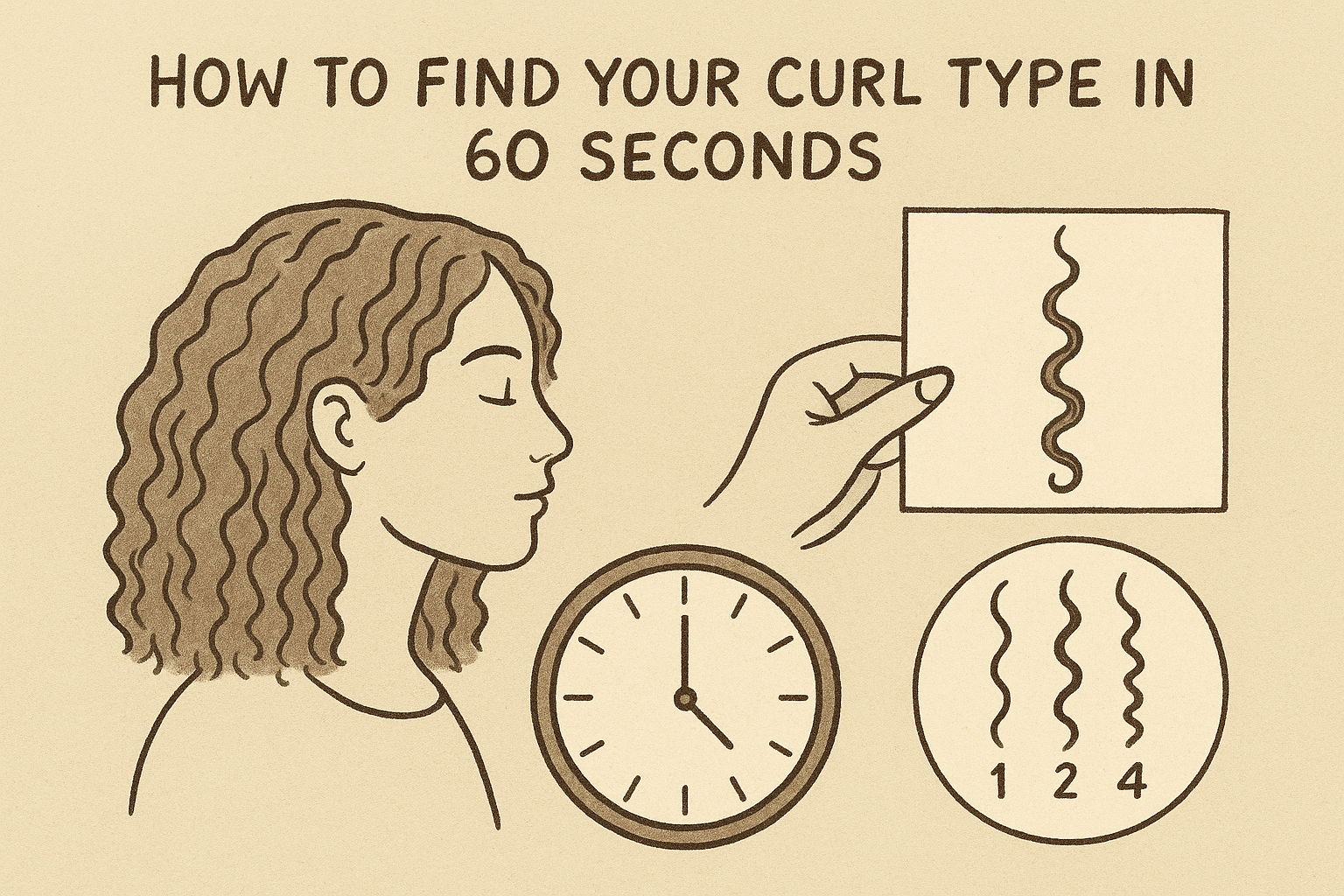
The fastest and most accurate way to identify your curl type requires one non-negotiable condition: your hair needs to be completely clean and fully air-dried with zero products applied. That's the entire setup. When you add a leave-in, gel, or even water to dry hair, you change how the strand behaves, and the pattern you see is no longer your natural baseline. The curl pattern chart only works if you're reading your actual hair, not a product-influenced version of it.
Check a single strand, not your whole head
Pull one strand from the mid-section of your head, away from the hairline and nape where your texture is often different from the rest. Hold it up to a white surface and look at how it bends. If it lies completely flat, you're type 1. A slight wave with no real curl shape puts you in type 2 territory. A defined spiral or ringlet signals type 3. Tight coils or a sharp zig-zag that barely stretches lands in type 4.
Checking one strand at a time removes the visual noise of your full head of hair, which makes it much harder to isolate any single pattern. Pick three or four strands from different sections to confirm what you're seeing, then identify which shape comes up most consistently. That's your dominant pattern.
Your hairline and nape are the least reliable spots to read your curl type - they almost always run a different texture than the rest of your head.
Read from root to end
Your roots and ends can tell very different stories. Fine or damaged ends tend to lose definition over time, which can make your type look looser than it actually is. Focus on the first two to three inches of growth from your scalp to get the clearest read on your natural pattern. That section is the least affected by heat history, chemical processing, and mechanical damage.
If you see a mix of patterns across different strands, that's completely normal. Most people with textured hair carry two or even three different curl types across their head. When that happens, identify the pattern that covers the most surface area and use that as your primary type when referencing the curl pattern chart.
Curl types 1 to 4 with quick identifiers
Each number on the curl pattern chart represents a different hair family, and the letters within each number describe how tight or loose the pattern runs. Use these quick identifiers to confirm what you noticed when you checked your individual strands in the previous step.
Types 1 and 2: straight and wavy
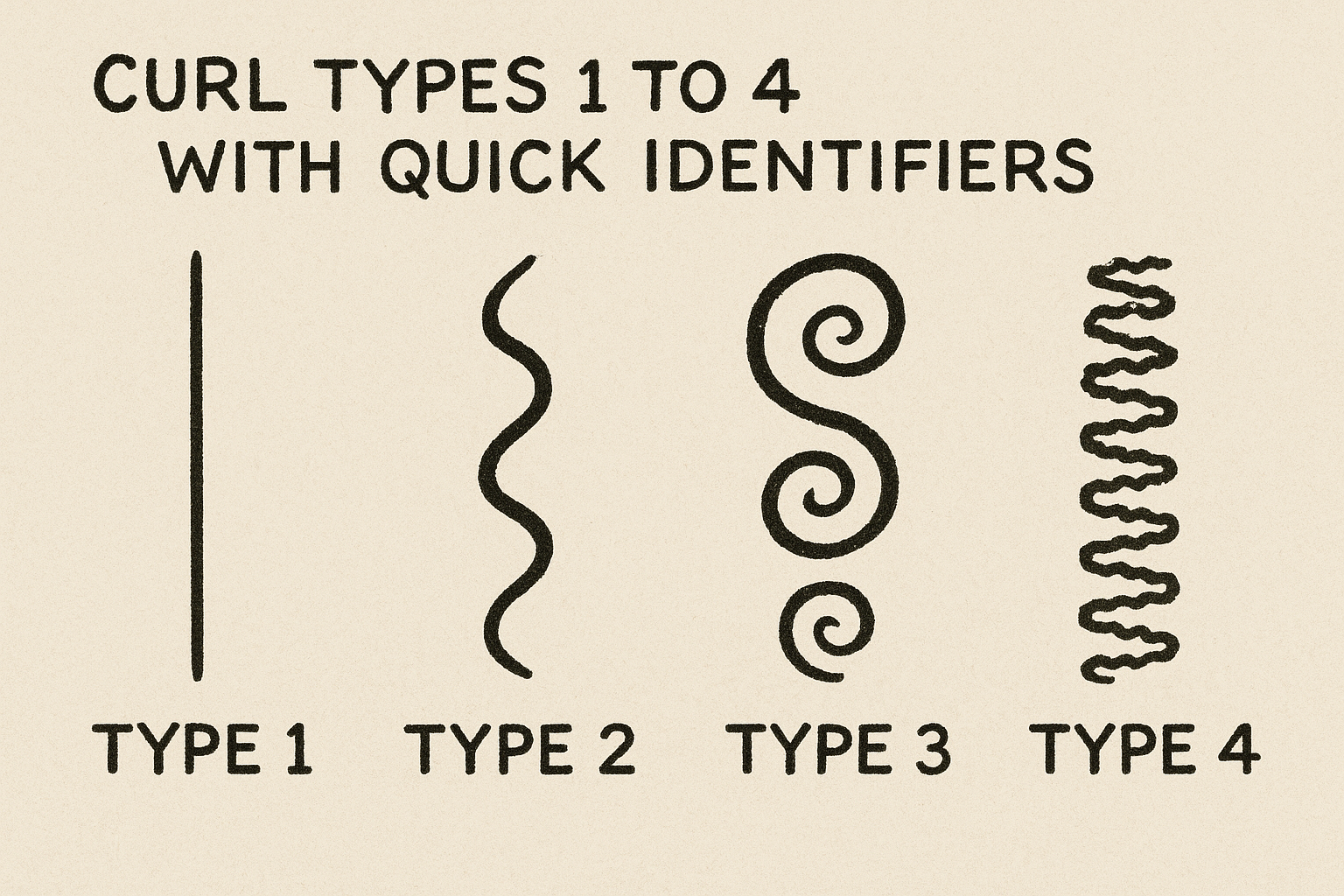
Type 1 hair is completely straight from root to tip with no natural bend. The A, B, and C subdivisions reflect how much shine and body the strand has, but none of them form any wave or curl. Type 1C is the thickest in the straight category, but a single strand held up will still drop in a straight line with no deviation.
Wavy hair (type 2) forms a soft S-wave you can see without stretching the strand. Type 2A has a barely visible wave, 2B produces a more defined wave that follows the shape of your head, and type 2C creates a clear S-shape that almost spirals before it falls. If your hair waves when wet but dries mostly straight, you're likely sitting on the lighter side of type 2.
The gap between a 2C and a 3A often comes down to whether the spiral closes fully or drops open - look at the whole strand, not just one bend in it.
Types 3 and 4: curly and coily
Type 3 hair forms a defined spiral that holds its shape after drying. Type 3A produces a large, loose ringlet roughly the width of a thick marker. Type 3B tightens into a springy medium ringlet, and type 3C produces a dense corkscrew coil that packs together and shows clear shrinkage once dry.
Coily hair in types 4A through 4C covers the tightest end of the chart and carries the widest range of behavior within a single category. Type 4A forms small, defined coils that still hold a visible circular shape when you stretch and release them. Type 4B shifts into a tight Z-pattern with sharp angles rather than rounded bends, and type 4C has the least defined shape of any curl type, with strands that coil tightly but rarely clump into a consistent pattern, making shrinkage above 75% of your actual hair length completely normal.
Care basics by curl family and common issues
Once you've placed yourself on the curl pattern chart, the next step is matching your daily care habits to how your specific curl family actually behaves. Each hair family has a predictable set of needs and a predictable set of problems that show up when those needs aren't met. Straight and wavy patterns struggle most with buildup and flatness, while curly and coily patterns fight against dryness and breakage. Knowing which camp you're in cuts your routine down to what actually moves the needle.
Straight and wavy (types 1 and 2): avoid the buildup trap
Types 1 and 2 have the most cuticle layers lying flat against the strand, which makes them naturally shinier but also much more prone to product and oil buildup. If you use heavy creams or thick leave-ins on wavy hair, you'll weigh the wave down within a few hours. Stick to lightweight gels, foam, and water-based sprays that enhance without coating the strand. Washing more frequently than coilier types is completely normal here, since scalp oils travel down the shaft faster on a straighter pattern.
The most common issue in this family is loss of definition by midday, usually caused by applying too much product or styling hair that wasn't fully saturated before you started. Apply your products on soaking wet hair, use less than you think you need, and let everything dry completely before you touch it.
Curly and coily (types 3 and 4): make moisture the priority
Types 3 and 4 have curl patterns that open the hair cuticle at each bend, which means moisture exits faster than it does in straighter types. Your core job is to seal moisture into the strand immediately after washing, while your hair is still dripping wet. Layering a water-based leave-in first and following it with a cream or gel gives your hair two layers of defense against dryness throughout the day.
The tighter your curl, the more deliberate your moisture routine needs to be - skipping steps here shows up fast as shrinkage without definition or edges that refuse to cooperate.
Breakage at the point of manipulation is the most common issue in types 4A through 4C. Detangle only on wet, conditioned hair using a wide-tooth comb or your fingers, and always work from the ends upward toward the root to avoid snapping strands mid-shaft.
Next steps for better curl days
You now have everything you need to read the curl pattern chart accurately, identify your dominant pattern, and match your care routine to how your specific hair type actually behaves. The chart is a starting point, not a finish line. Your next move is to take what you learned here and apply it on your next wash day: clean hair, no products, and a close look at a few individual strands before you reach for anything.
From there, pay attention to how your hair responds over several wash days, not just one. Real patterns emerge over time, and small adjustments to your product weight or application method will tell you more about your hair than any chart ever could. If you want formulas built specifically for textured hair that performs, explore what Scatter is building and get early access before the 2026 launch.