

How To Repair Hair Breakage: 12 Tips For Stronger Hair
You run your fingers through your hair and notice short, frizzy pieces sticking up everywhere. Or maybe you spot broken strands on your pillowcase, your shirt, your bathroom counter. If you're searching for how to repair hair breakage, you already know something's off, and you want to fix it before it gets worse. The good news: you can cut down on a lot of breakage once you understand what's causing it and what steps make a difference.
Breakage hits differently when you have textured hair. Curls, coils, and waves are naturally more vulnerable to snapping because of how the hair shaft bends and twists. Every curl pattern creates a potential weak point, which means textured hair needs a more intentional approach to care and prevention. Generic advice doesn't always cut it, and products that ignore your texture can sometimes make things worse.
Below, you'll find 12 practical tips to cut down on breakage, keep hair softer and more flexible, and get your hair back to where you want it.
1. Confirm you have breakage, not shedding
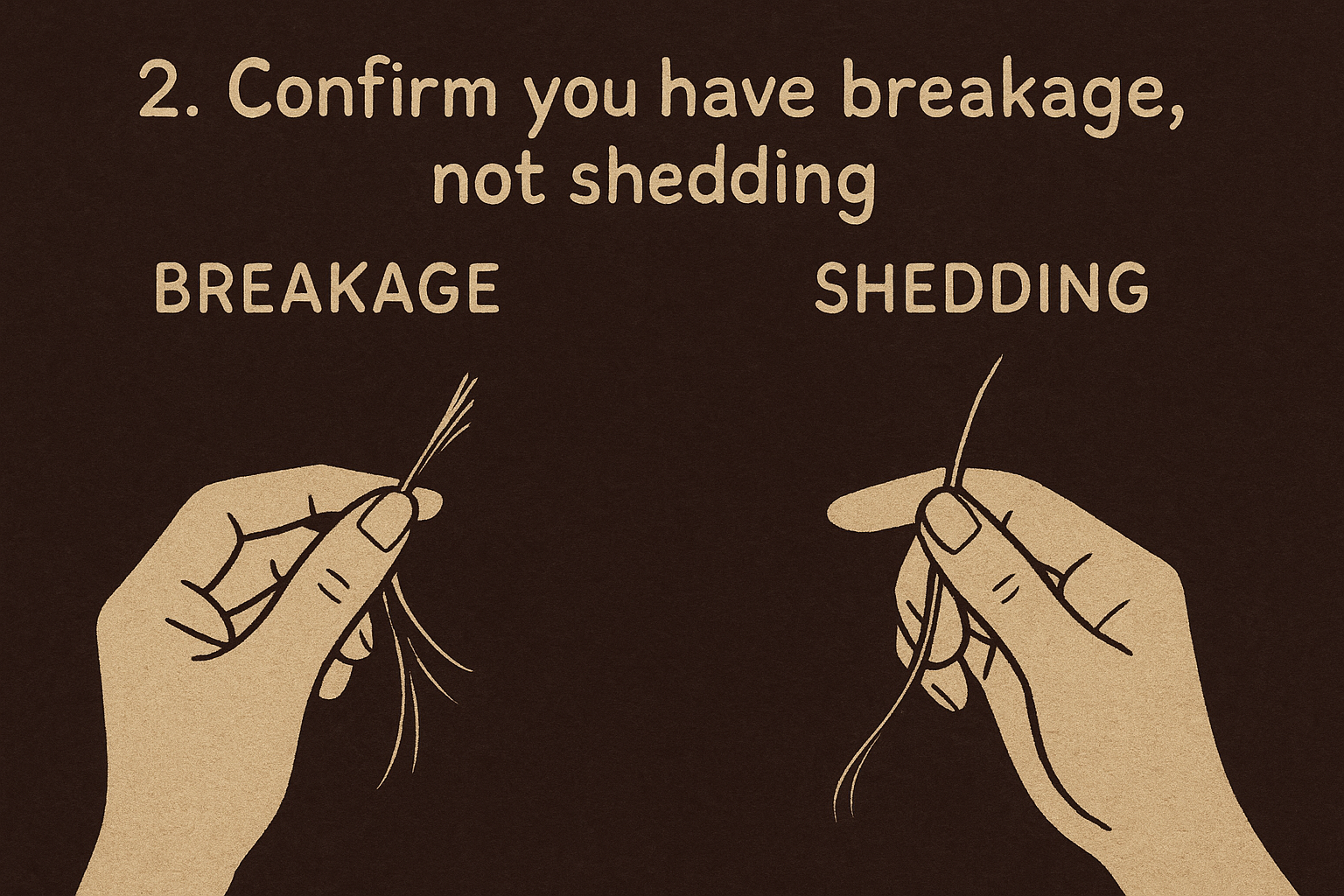
Before you start changing your routine to figure out how to repair hair breakage, make sure breakage is actually what you're dealing with. Shedding and breakage look similar but have different causes and solutions, and treating the wrong one wastes time.
What to do
Pick up a few strands from your brush, shirt, or shower floor. Check the length: a shed hair will be close to your full hair length and will have a small white bulb at the root end. A broken strand will be noticeably shorter with no bulb, and both ends appear frayed or blunt rather than tapered.
If you find a mix of both, that's normal. Focus your efforts on the shorter, bulb-free strands since those confirm actual breakage.
Why it helps
Chasing the wrong problem leads to the wrong fix. Shedding is a natural part of the hair's shedding cycle, so treating it as damage can push you toward unnecessary protein treatments or product overload. Breakage signals a structural issue in the hair shaft that needs targeted care.
Knowing exactly what you're dealing with keeps your routine focused and effective.
Pro tips for textured hair
Textured hair sheds more visibly because shed strands get trapped in your curl pattern instead of falling freely throughout the day. This makes normal shedding look alarming when you finally detangle.
Count shed hairs after detangling: losing 50 to 100 strands is within the normal daily range for most people. Anything consistently above that warrants a closer look at your detangling technique.
2. Trim split ends before they travel
When you're learning how to repair hair breakage, trimming is often the step people avoid the longest. That resistance is understandable since cutting hair feels counterintuitive when you're trying to grow it, but leaving split ends in place guarantees more breakage, not less.
What to do
Schedule a trim every 8 to 12 weeks, or sooner if you spot visible splits during styling. Ask your stylist for a search-and-destroy trim if you only want to cut the visibly split sections rather than a uniform length across all your ends.
A small dusting of a quarter-inch to half-inch removes the damage without sacrificing meaningful length. You don't need a major cut to make real progress here.
Why it helps
A split end doesn't stop at the tip. The hair shaft fiber continues separating upward toward the root over time, and no product can permanently fuse it back together. Conditioner and oils can temporarily smooth the cuticle, but the underlying split remains active.
Trimming removes the damage before it travels further up the shaft and creates breakage higher on the strand.
Cutting your ends regularly keeps the tips tidy, which reduces the number of weak points that can snap under styling, detangling, or everyday friction.
Pro tips for textured hair
Textured hair hides split ends inside curl coils, which makes damage harder to spot until it's already significant. Stretch a few strands gently under good lighting to check your ends more accurately before each trim.
Trim on dry, stretched hair rather than wet hair so you can see your actual length and avoid cutting more than you intend. Wet hair stretches and can make your ends appear longer and healthier than they actually are.
3. Detangle gently with slip and the right tools
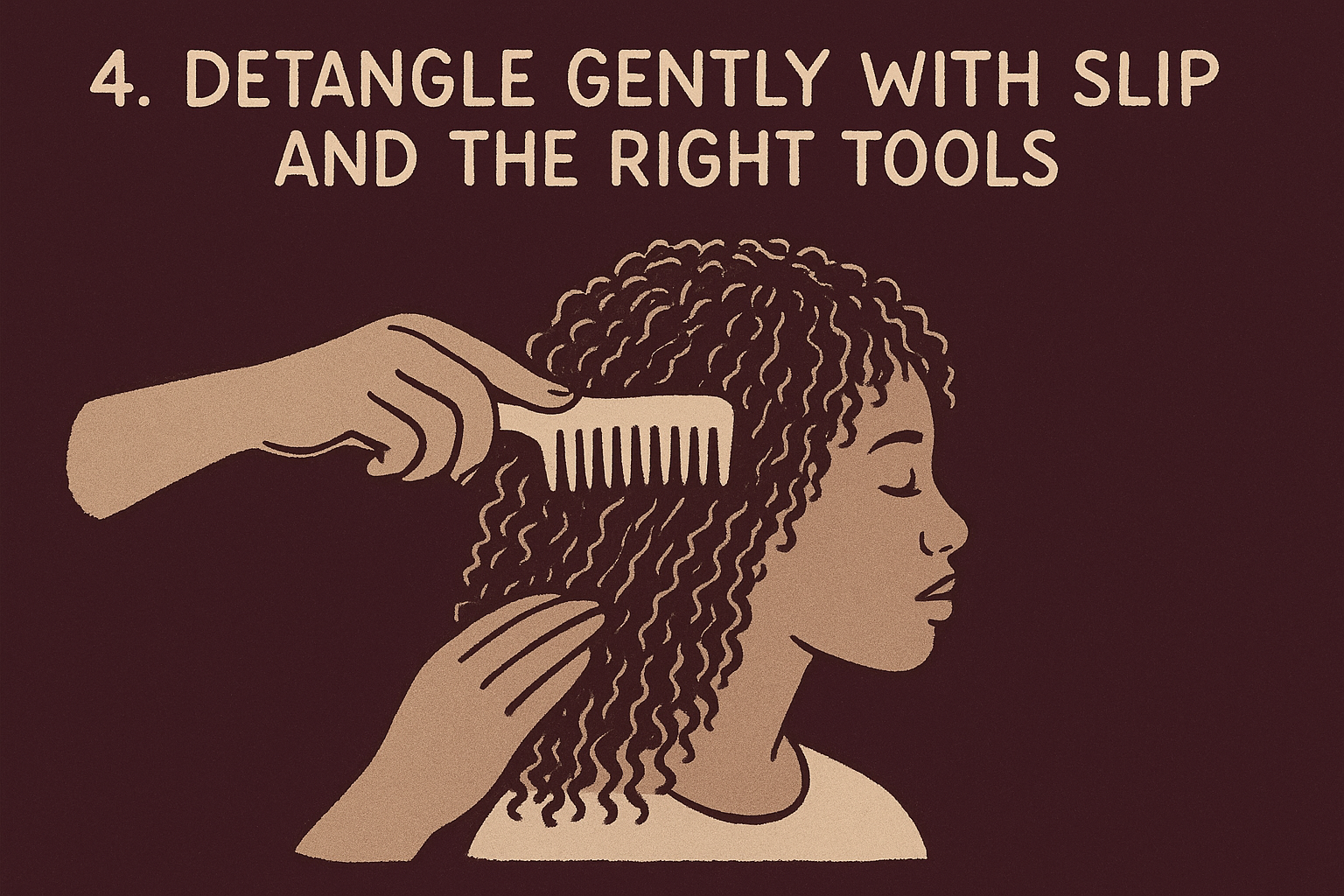
Detangling is one of the biggest sources of mechanical breakage for textured hair. Every knot you force through without enough slip or with the wrong tool creates micro-tears that add up fast. Getting this step right is a core part of learning how to repair hair breakage and stopping new damage from replacing the old.
What to do
Work detangling into your routine on wet, conditioned hair rather than dry hair whenever possible. Apply a generous amount of conditioner or a dedicated detangling product before you even reach for a tool.
Use your fingers first to break apart larger knots, then follow with a wide-tooth comb or a detangling brush built for textured hair. Always start at the ends and work your way up toward the roots, never root to tip.
Why it helps
Starting at the ends prevents you from forcing knots down the shaft, which multiplies tension on each strand. Working section by section keeps you from overloading any single area with repeated passes.
Slip reduces the friction between strands, which is what allows knots to release without snapping the hair.
Pro tips for textured hair
Divide your hair into four to six sections before you start. Smaller sections mean less tangling between areas and more control over each pass with your tool. Clip away sections you're not actively working on so they don't re-tangle while you move through the rest.
Avoid detangling dry or nearly dry hair unless you're using a product built specifically for that purpose. Textured strands in a dry state have far less elasticity and will snap under the same pressure that well-conditioned wet hair handles easily.
4. Wash your scalp, not your lengths
How you shampoo matters just as much as how often you shampoo. Scrubbing shampoo directly into your lengths and ends strips moisture from the most fragile parts of your hair, and that repeated dryness leads to brittleness and snapping over time.
What to do
Apply shampoo only to your scalp, using your fingertips in small circular motions to loosen buildup. Let the rinse water carry the shampoo down the length of your strands as it flows out. You don't need to work the product through your mid-lengths or ends at all.
Focus each wash on your scalp, not your overall hair volume. Clean lengths come as a byproduct of rinsing without requiring direct shampoo contact.
Why it helps
Your scalp produces natural oils that travel down the hair shaft and provide some protection, but those oils have a harder time reaching your ends because of how textured hair coils and bends. Shampooing your ends directly strips whatever moisture they've retained and leaves them even more vulnerable to breakage.
Keeping shampoo off your ends preserves the moisture barrier that holds each strand together during styling and everyday wear.
Pro tips for textured hair
Textured hair dries out faster than straight hair, so protecting your ends during wash day is one of the most direct ways to address how to repair hair breakage without changing your entire routine at once.
Rinse with cool or lukewarm water rather than hot water. Hot water opens the cuticle aggressively, and for textured strands already prone to moisture loss, that extra exposure adds up across every wash day.
5. Condition every wash and deep condition weekly
Conditioning is not optional if you're serious about how to repair hair breakage. Regular conditioner replenishes surface moisture after every wash, while a weekly deep conditioning treatment helps restore softness and flexibility.
What to do
Apply a rinse-out conditioner to your mid-lengths and ends every single wash day, no exceptions. Leave it on for at least three to five minutes before rinsing. Once a week, swap that rinse-out conditioner for a deep conditioning mask or treatment, and leave it on for 20 to 30 minutes under a plastic cap to maximize absorption. Heat from a hooded dryer or a warm towel wrapped around the cap speeds up penetration significantly.
Why it helps
Each wash cycle strips some moisture from your strands, and regular conditioner replaces what's lost before dryness has a chance to make your hair brittle. Deep conditioners go further by temporarily filling gaps in a damaged or porous cuticle, which helps hair feel softer and more flexible under normal manipulation.
Hair that bends without breaking is hair that's been consistently conditioned, not just occasionally treated.
Pro tips for textured hair
Textured hair is more porous than straight hair, which means it absorbs moisture quickly but also releases it just as fast. Focus your deep conditioner application on your ends and the most manipulated sections, since those areas experience the most repeated stress and lose moisture the fastest. Rinse with cool water after to seal the cuticle down and lock in what you just added.
6. Balance moisture and protein in your routine
Understanding how to repair hair breakage often comes down to one overlooked factor: the balance between moisture and protein inside each strand. Too much of one and not enough of the other leaves your hair either limp and mushy or stiff and snapping, and both states cause breakage in different ways.
What to do
Check how your hair responds after wash day. Moisture-overloaded hair feels soft and stretchy but snaps when pulled, almost like a rubber band. Protein-overloaded hair feels stiff, rough, and snaps immediately with no stretch. Once you identify which side you're on, adjust accordingly by adding a protein treatment if your hair lacks structure, or a deep conditioning session if it feels dry and rigid.
Alternating between a moisture-focused and a protein-focused treatment every few weeks keeps both in balance without constant guessing.
Why it helps
Hair is made of keratin protein, and moisture keeps that protein flexible. When one drops too low, the structural integrity of the shaft weakens and breakage becomes almost unavoidable during everyday manipulation.
Bringing both back into balance can also help hair feel more flexible, which is what lets a strand stretch under tension and return without snapping.
Pro tips for textured hair
Textured hair tends to run on the moisture-deficient side because of how its shape limits natural oil distribution along the strand. Start with a mild protein treatment containing hydrolyzed keratin or rice protein, then assess how your hair feels after 48 hours before reaching for a stronger formula.
Pay attention to how your ends feel specifically. Your ends are the oldest and most processed part of each strand, so they usually show protein or moisture imbalance first and respond fastest when you correct it.
7. Consider a bond-care product after bleach, color, or relaxers
Chemical services can affect the disulfide bonds inside the hair shaft. If you've bleached, colored, or relaxed your hair and are now dealing with snapping, a bond-care product is worth a look as part of how to repair hair breakage caused by chemical services.
What to do
Add a bond-care treatment to your routine after any chemical service. Ingredients like bis-aminopropyl diglycol dimaleate are common in professional bond-care treatments. Use the treatment as a pre-shampoo step or in-salon add-on before your next wash, then keep up with a bond-care conditioner or serum in between sessions.
Why it helps
Chemical processes don't just affect the outside of your hair. They also affect internal bonds in the strand, which is why bleached, colored, or relaxed hair often feels more fragile. Bond-care products are an option some people add for this kind of hair.
Gentle habits matter most for chemically treated hair, with or without a bond-care product.
Pro tips for textured hair
Textured hair that's been chemically processed and heat-styled tends to be under more stress than most people realize. Follow the product's directions for how often to use it, and space chemical services out when you can.
8. Reduce heat and improve your heat technique
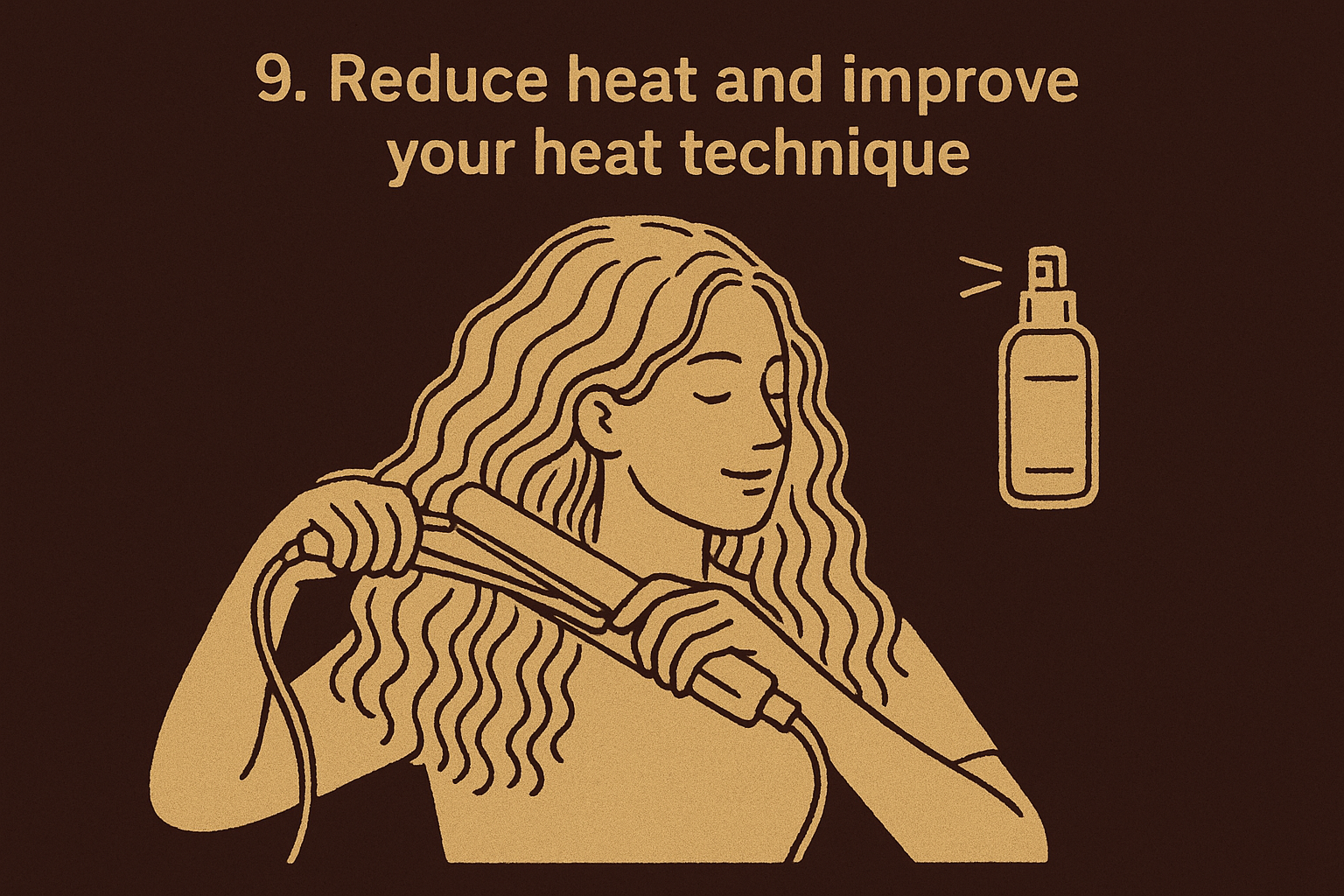
Heat is one of the fastest ways to weaken your hair shaft, and it's also one of the most fixable parts of how to repair hair breakage. You don't have to give up flat irons or blow dryers entirely, but the way you apply heat matters far more than most people realize.
What to do
Apply a heat protectant to every section before any direct heat touches your hair. Set your tool to the lowest effective temperature for your hair type, which for textured hair typically falls between 300°F and 375°F rather than the maximum setting. Pass each section through your heat tool in a single smooth stroke rather than clamping down and holding it in one spot.
Why it helps
High heat breaks down the protein structure inside the hair shaft, weakening the strand at the point of contact. Repeated passes at high temperatures compound that damage with every use.
Lowering your heat setting can reduce the stress each session puts on your hair.
A heat protectant forms a barrier between the tool and your cuticle, slowing heat transfer and giving your strand a layer of protection it otherwise lacks.
Pro tips for textured hair
Textured hair is particularly vulnerable to heat damage because the bends and coils in each strand create uneven contact with the tool. Work in thinner sections so heat distributes evenly across the full strand rather than concentrating at the points where the hair naturally curves. This single adjustment reduces both heat exposure and the number of passes you need to finish each section.
9. Stop tight styles and tension at the roots
Chronic tension is one of the most common and most ignored factors in how to repair hair breakage. Tight ponytails, braids, and buns pull repeatedly on the same root areas, stressing the hair there and snapping strands where stress concentrates most.
What to do
Loosen up any style that leaves your scalp feeling tight, sore, or tender after a few hours of wear. Switch to styles that distribute weight and tension more evenly, like loose twists, buns secured with a scrunchie, or protective styles installed without excessive pulling at the hairline. Give your hair at least one or two completely tension-free days each week to let your roots recover between styles.
If you wear braids or locs, communicate clearly with your stylist about keeping the installation comfortable from the start, not just tolerable. A good rule: if it hurts going in, it's already too tight.
Why it helps
Repeated tension at the roots keeps stress on the same strands day after day, and that is what leads to snapping. Catching this early and releasing the tension gives your hair a real chance to recover before the damage builds.
A sore scalp after styling is a warning, not something to push through.
Pro tips for textured hair
Textured hair naturally concentrates tension points at the edges and nape, where curl patterns are often finer and more fragile. Pay close attention to your hairline and the back of your neck when evaluating how a style feels. Those areas break faster than the rest of your hair when styles are consistently too tight.
10. Prevent breakage from friction and snagging
Friction is a slow, invisible form of damage that builds every single day. Your hair rubs against clothing collars, seatbelts, bag straps, and rough fabric throughout the day, and each contact point creates wear on the cuticle that eventually leads to snapping. Addressing friction is a practical but often skipped step in how to repair hair breakage that costs almost nothing to fix.
What to do
Swap out rough cotton accessories for smoother alternatives wherever your hair makes repeated contact. Use a microfiber towel or an old soft cotton t-shirt to squeeze out water after washing instead of rubbing vigorously with a standard bath towel. Avoid wearing your hair loose against high-friction materials like wool or textured knit collars for long stretches of time.
When styling, reach for seamless hair ties or spiral coils instead of elastics with metal clasps that catch and pull strands. Remove accessories carefully by unwinding rather than yanking them free in one motion.
Why it helps
Every time your cuticle catches on a rough surface, small scales lift and chip away, leaving the inner cortex exposed and structurally weaker. Those micro-abrasions create consistent weak points along the same sections of hair over time, which is why breakage often shows up concentrated at a specific length that matches exactly where your collar or bag strap sits daily.
Reducing daily friction points gives your cuticle a chance to stay intact between wash days instead of absorbing fresh damage every few hours.
Pro tips for textured hair
Textured hair has a raised, multi-directional cuticle that snags on rough surfaces more easily than straight hair does. Tuck your ends away from high-friction zones when you're wearing defined styles, and choose smoother outer fabrics for everyday wear to keep your ends protected throughout the day.
11. Protect hair at night with satin and low tension
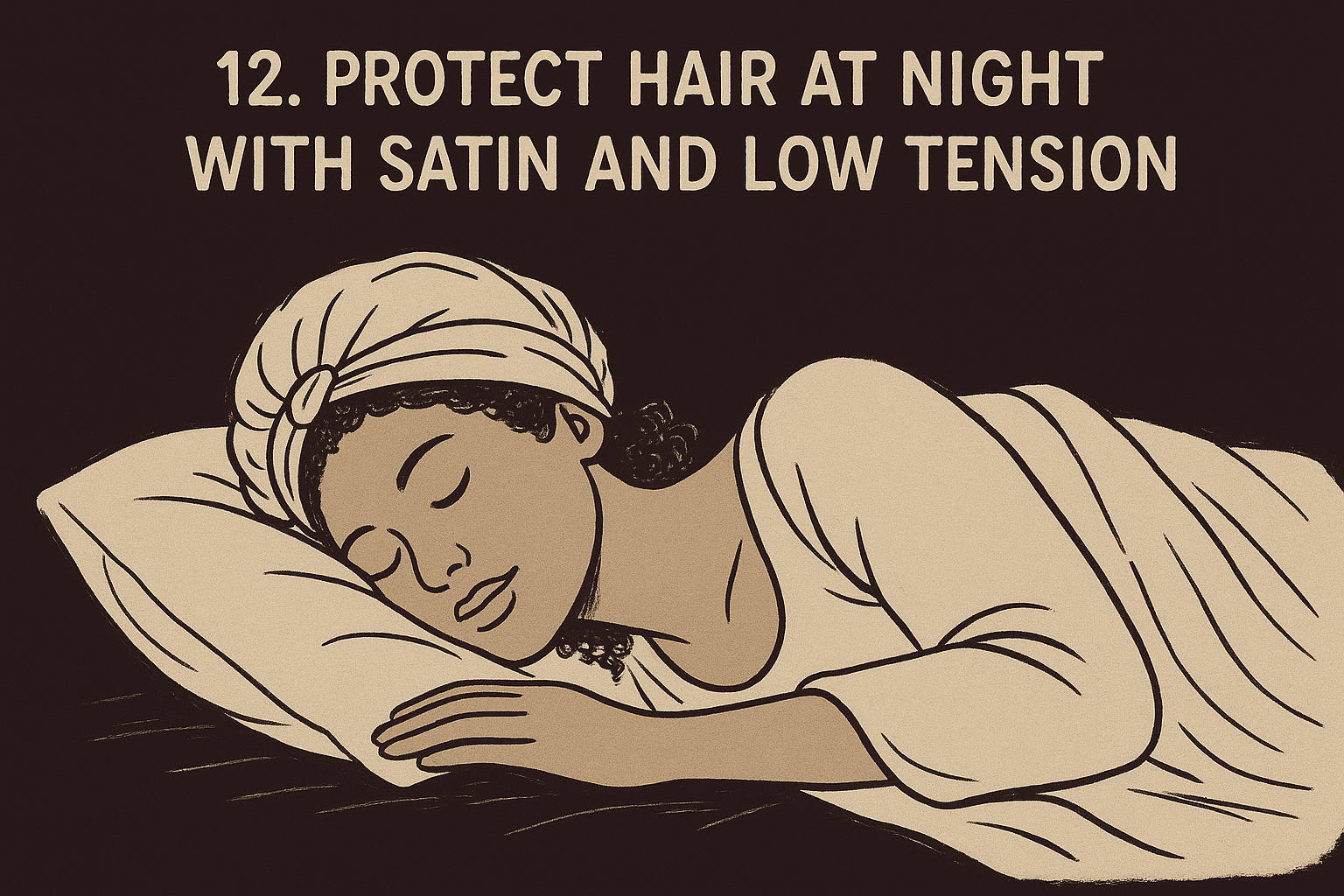
Every night your hair spends pressed against a rough cotton pillowcase, it absorbs hours of friction and tension that chips away at your cuticle while you sleep. Nighttime protection is one of the simplest upgrades in how to repair hair breakage, and it compounds fast because you do it every single day.
What to do
Switch to a satin or silk pillowcase, or wrap your hair in a satin-lined bonnet or scarf before bed. Either option works. The goal is to eliminate direct contact between your strands and any rough, absorbent surface for the full time you're sleeping. If you prefer a bun or pineapple to protect your style overnight, secure it loosely at the top of your head with a soft scrunchie or spiral coil rather than a tight elastic.
Why it helps
Cotton fabric has a texture that grabs and pulls at your cuticle with every small movement you make during the night. Satin and silk have a much smoother surface that lets your hair glide rather than catch, which keeps the cuticle flat and intact by morning.
Less friction while you sleep can help your ends hold up over weeks and months.
Pro tips for textured hair
Textured hair is especially prone to overnight tangling and compression, which causes knots that require aggressive detangling the next day and leads to more breakage. A loose pineapple or two-strand twist-out pinned gently on top of your head keeps your curl pattern preserved and reduces the tangles you wake up to, so your morning routine starts with less stress on your strands.
12. Fix buildup, hard water, and other hidden stressors
Some sources of breakage have nothing to do with your styling habits or product choices. Mineral deposits from hard water and product buildup on your strands create a layer of residue that blocks moisture from entering the hair shaft, leaving your hair stiff, brittle, and prone to snapping. Identifying these hidden stressors is a practical final step in how to repair hair breakage that most routines miss.
What to do
Use a clarifying shampoo once a month to cut through the product buildup that regular shampoo leaves behind. If you live in an area with hard water, install a shower filter to reduce mineral deposits before they reach your strands. Check which issue applies to your situation:
- Product buildup: hair feels coated, weighed down, or stops responding to conditioner
- Hard water: strands feel stiff and rough even after deep conditioning
- Both: use a chelating shampoo, which removes mineral and product residue at once
Why it helps
Buildup and mineral deposits act as a physical barrier that prevents your conditioner and treatments from reaching the hair shaft. Even a solid routine loses most of its effectiveness when residue is blocking absorption.
Clearing that surface layer lets every product you apply afterward actually do its job.
Removing these hidden stressors also helps your hair hold moisture between wash days, which reduces the dryness and brittleness that lead to snapping.
Pro tips for textured hair
Textured hair traps buildup inside curl coils more than straight hair does, which makes clarifying a non-negotiable part of your routine. Follow every clarifying session immediately with a deep conditioning treatment since clarifying removes moisture along with residue and your strands need it replaced right away.
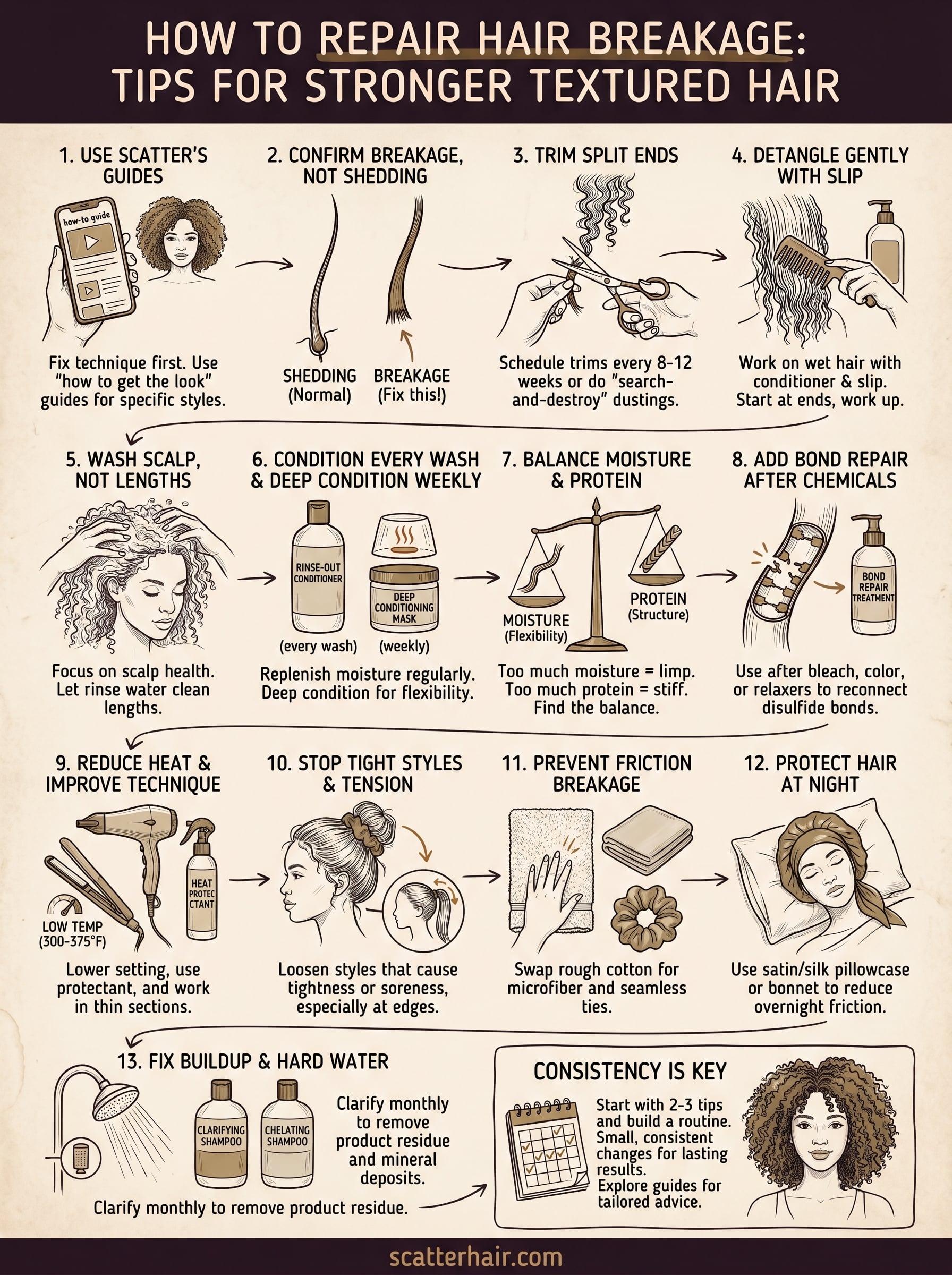
A simple plan you can stick with
Knowing how to repair hair breakage is only half the work. The other half is building a routine you actually repeat consistently, because breakage doesn't ease up after a single wash day. Start with two or three tips from this list that address your most obvious problems, whether that's your detangling method, your nightly routine, or your heat habits, and build from there.
Small, consistent changes outperform dramatic overhauls every time. Fix your technique first, then layer in the right products as you go. Your hair responds to what you do repeatedly, not what you do once.
Scatter's first product is Slip, a 2% hyaluronic acid hair serum. Work it through wet-to-damp hair, then air dry for texture or blow dry for body. It's on pre-order now.