

Dry Scalp vs Dandruff: How to Tell the Difference
You're seeing white flakes on your shoulders, your scalp feels off, and you're not sure what's going on. The dry scalp vs dandruff difference might seem subtle at first glance, but these are two distinct conditions with different causes and treatments. Mixing them up often means using the wrong products, which can make things worse.
Here's the thing, both conditions hit harder when you have textured hair. Curls, coils, and waves already demand more moisture and intentional care, so an irritated scalp throws the whole routine off. At scatterhair, we're building styling products specifically for textured hair, and we know that great styling starts with a healthy scalp. You can't rock your texture if the foundation underneath is struggling.
This guide breaks down exactly how to tell these two conditions apart, what causes each one, and how to treat them so you can get back to styling without the guesswork.
Why the difference matters
If you grab an anti-dandruff shampoo and your real issue is dry scalp, you're likely making things worse. Anti-dandruff formulas often contain active ingredients like zinc pyrithione or selenium sulfide, which target fungal overgrowth, not moisture loss. Using them on an already dehydrated scalp strips away even more natural oil, increasing dryness, tightness, and irritation. Understanding the dry scalp vs dandruff difference is the first step to choosing a treatment that actually resolves the problem instead of compounding it.
Using the wrong treatment makes things worse
The opposite mistake is just as common. If you load up on heavy oils and moisturizing treatments to soothe what feels like dryness, but the real problem is a fungal imbalance, you're feeding the issue. The fungus responsible for dandruff, Malassezia, thrives in oily environments. Adding more oil to your scalp without addressing the underlying imbalance can trigger more inflammation, more flaking, and more itching, not less.
Applying heavy oils to treat what you assume is dryness can feed the fungal growth that's actually driving your dandruff.
Many people cycle through product after product without improvement because they never pinned down the actual condition. You might try a clarifying shampoo, then a deep moisturizing mask, then a medicated treatment, all in the wrong order because the root cause stayed unconfirmed. That kind of guesswork wastes time and money and keeps your scalp in a constant state of irritation. Getting the identification right up front saves you from that loop entirely.
Textured hair raises the stakes
For people with textured hair, getting this wrong has a bigger impact than it might for someone with straight hair. Curly, coily, and wavy hair types produce sebum that has a harder time traveling down the length of the hair shaft because of the curl pattern. That means the scalp is already working harder to stay balanced, and when something disrupts that balance, the effects show up faster and more noticeably.
When your scalp is compromised, whether by dryness or by dandruff, it directly affects moisture retention and curl definition. An irritated scalp also becomes more reactive to manipulation, heat, and the styling products you apply. You might notice your curls looking dull, feeling brittle, or losing their shape earlier in the day. These are signals that something at the root level is off. Identifying the condition correctly means you can treat it precisely, rather than burying the problem under more layers of product.
Scalp health is not a side issue separate from your styling routine. It is the foundation. When you know what your scalp actually needs, every other step you take, from washing to conditioning to styling, works better because it starts from a stable base.
How to tell dry scalp from dandruff
The fastest way to start narrowing down the dry scalp vs dandruff difference is to take a close look at what's actually showing up on your scalp and shoulders. Both conditions produce flakes, but the type, size, and texture of those flakes give you reliable clues without needing a dermatologist visit.
Check the flakes first
Dry scalp flakes are typically small, white, and fine in texture. They tend to fall off easily and scatter when you touch your hair. Dandruff flakes, on the other hand, are larger, often yellowish or grayish, and have an oily quality that makes them stick to the hair shaft rather than drift off freely.
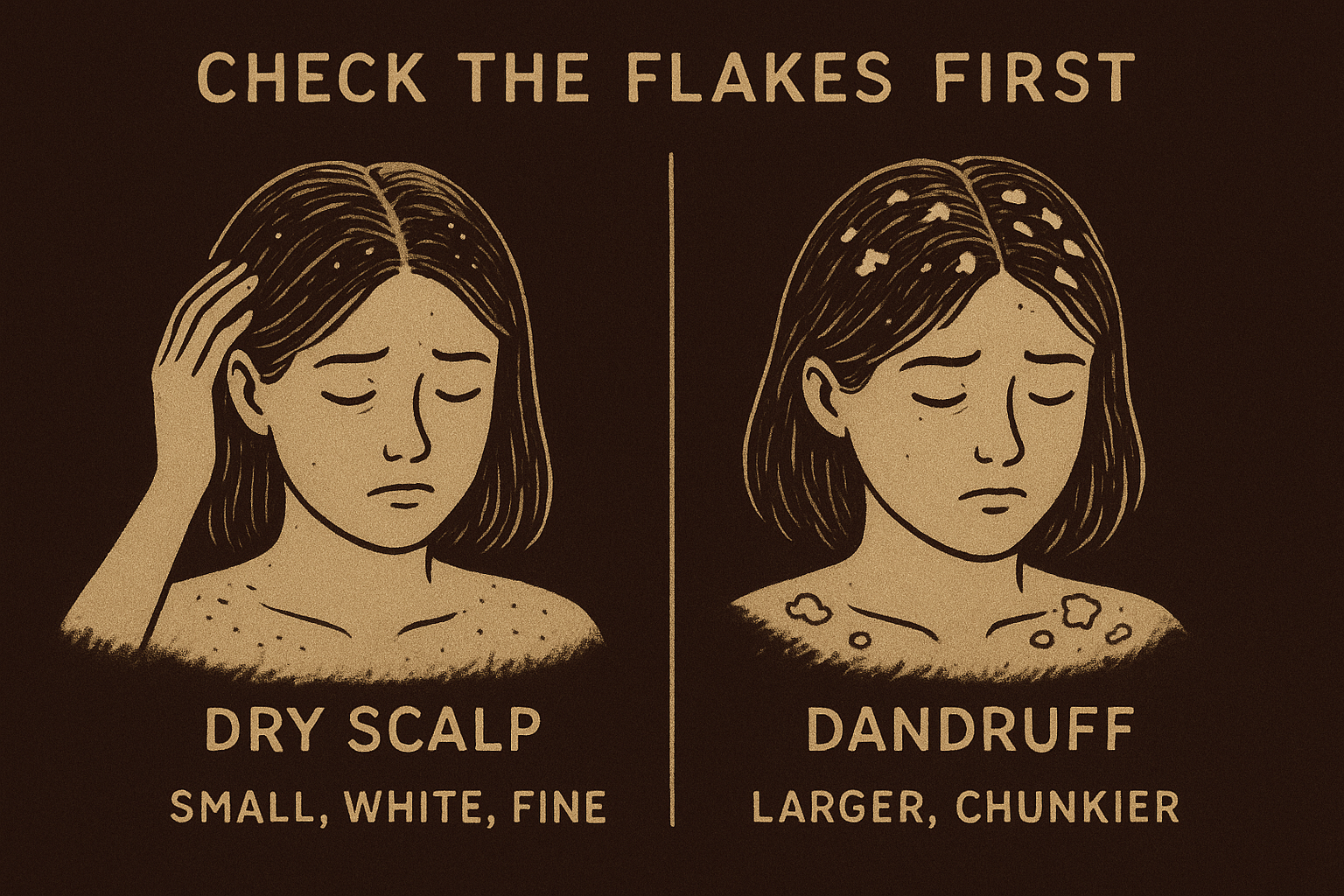
If your flakes cling to your strands and look slightly greasy, dandruff is more likely the cause.
| Feature | Dry Scalp | Dandruff |
|---|---|---|
| Flake size | Small, fine | Larger, chunkier |
| Flake color | White | White to yellowish |
| Texture | Dry, powdery | Oily, waxy |
| Where they land | Fall freely onto shoulders | Stick to hair shaft |
Pay attention to how your scalp feels
Dry scalp usually comes with a feeling of tightness, sensitivity, or general discomfort, similar to how dry skin feels on your face after washing without moisturizer. Dandruff more commonly produces persistent itching and sometimes visible redness or irritation at the scalp surface.
Your scalp's overall oil level is another useful indicator. If your roots feel greasy fairly quickly after washing, dandruff is the more likely issue. If your scalp feels tight or rough and your hair dries out fast, moisture deficiency is probably driving the flaking. Tracking these signals over a few wash cycles gives you a much clearer picture of which condition you're actually dealing with.
What causes flakes and itch on the scalp
Understanding what triggers each condition helps you connect the dry scalp vs dandruff difference to what's actually happening in your daily routine. The causes are distinct at the root level, which is exactly why the treatments differ so significantly.
What drives dry scalp
Dry scalp comes down to one thing: insufficient moisture. Your scalp skin dries out when it loses more water than it retains, and several factors accelerate that process. Cold or dry weather, low humidity environments, over-washing with harsh cleansers, and hot water during showers all strip moisture from the scalp barrier faster than it can recover.
Certain hair care products also contribute directly. Shampoos with high concentrations of sulfates remove natural oils aggressively, leaving your scalp tight and flaky after every wash. For people with textured hair, this is especially relevant because wash-day frequency and product choices have an outsized effect on scalp moisture levels compared to straighter hair types.
What drives dandruff
Dandruff has a biological cause: an overgrowth of a naturally occurring yeast called Malassezia. This yeast lives on everyone's scalp, but in some people it grows out of balance, feeding on the sebum your scalp produces. The result is accelerated skin cell turnover, which creates the oily, clumped flakes dandruff is known for.
Dandruff is not caused by poor hygiene; it is driven by a fungal imbalance that hygiene alone cannot fix.
Several factors make Malassezia overgrowth more likely, including hormonal shifts, stress, and excess oil production. People with naturally oilier scalps are more prone to dandruff because the yeast has a more abundant food source. Skin conditions like seborrheic dermatitis fall into the same category and produce similar symptoms at a more intense level, often requiring targeted medical treatment rather than over-the-counter options.
How to treat a dry scalp at home
Once you've confirmed that moisture loss, not fungal overgrowth, is driving your flaking, treatment becomes straightforward. Unlike dandruff, which requires targeting a biological imbalance, dry scalp responds well to consistent hydration and gentle product choices. The dry scalp vs dandruff difference becomes especially practical here because the same solution that fixes one condition can worsen the other, so knowing which you're dealing with keeps your approach on track.
Adjust your wash routine
Your washing habits play a direct role in how hydrated your scalp stays between sessions. Hot water and sulfate-heavy shampoos are two of the fastest ways to strip your scalp's natural oils, so switching to lukewarm water and a gentle, sulfate-free cleanser can reduce dryness noticeably within a few wash cycles. If you're washing daily or every other day, consider spacing washes out to give your scalp time to rebuild its moisture barrier.
Reducing wash frequency by even one day per week can give your scalp enough time to restore its natural oil balance.
For people with textured hair, this adjustment carries extra weight since the curl pattern already slows sebum distribution down the hair shaft, making scalp moisture harder to maintain in the first place.
Add moisture back in
Restoring hydration to a dry scalp requires ingredients that both attract and seal in moisture. Look for products containing hyaluronic acid, glycerin, or aloe vera, which draw water into the scalp, paired with lightweight oils like jojoba or sweet almond oil that seal without creating the greasy buildup that feeds fungal growth. Apply these to a damp scalp after washing for better absorption.
Avoid layering heavy butters or thick creams directly on your scalp, since excessive product buildup can clog follicles and create new problems on top of the dryness you're trying to fix.
How to treat dandruff and prevent flare-ups
Treating dandruff requires a different approach than treating a dry scalp, and knowing the dry scalp vs dandruff difference is what keeps you from wasting time on the wrong fix. Because dandruff stems from fungal overgrowth rather than moisture loss, your primary goal is to reduce Malassezia activity on the scalp, not to add hydration.
Use the right active ingredients
Medicated shampoos are the most reliable starting point for dandruff. Look for active ingredients specifically formulated to target fungal imbalance on the scalp, such as zinc pyrithione, ketoconazole, selenium sulfide, or pyrithione zinc. Each works slightly differently, so if one does not produce results within three to four weeks, switching to another active ingredient is worth trying rather than abandoning medicated options entirely.
Consistency matters more than frequency when using medicated shampoos since irregular use gives Malassezia room to recover between treatments.
Use the medicated shampoo two to three times per week during an active flare, leaving it on your scalp for a few minutes before rinsing so the active ingredient has time to work. Once flaking is under control, stepping back to once a week helps maintain the balance without over-stripping the scalp.
Build habits that keep flare-ups from coming back
Managing dandruff long-term comes down to reducing the conditions that trigger Malassezia overgrowth. Stress is a well-documented flare factor, and while eliminating it entirely is unrealistic, managing it actively through sleep, exercise, and routine keeps your scalp more stable over time.
Avoid applying heavy oils directly to your scalp between wash days, since excess sebum feeds fungal growth. If you use scalp treatments or styling products that reach the roots, choose lightweight, water-based formulas that do not leave a thick residue. Keeping your scalp environment balanced, rather than oily, is what makes the difference between occasional flares and a chronic cycle.
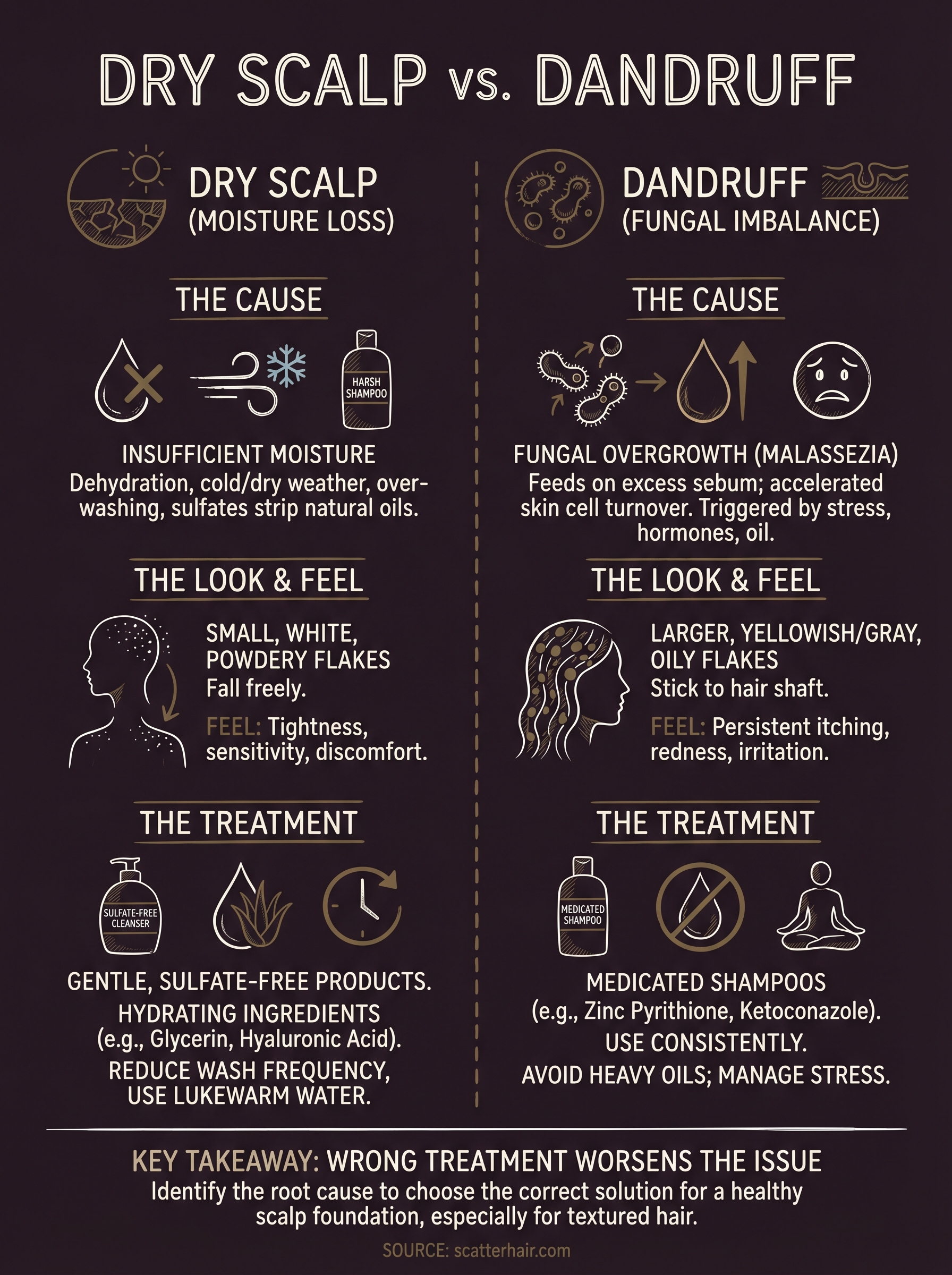
Key takeaways
The dry scalp vs dandruff difference comes down to cause: one is a moisture problem, the other is a fungal imbalance. Dry scalp produces small, white, powdery flakes and a feeling of tightness, while dandruff shows up as larger, oily flakes that stick to your hair shaft and drive persistent itching. Treating the wrong condition with the wrong product keeps your scalp stuck in a cycle that never fully resolves.
Your treatment approach needs to match the actual cause. Dry scalp responds to gentle cleansers, hydrating ingredients, and reduced wash frequency, while dandruff requires active antifungal ingredients like zinc pyrithione or ketoconazole used consistently over time. For textured hair especially, getting this right matters because scalp health directly affects how your curls look, feel, and hold throughout the day.
Healthy styling starts at the root. If you want products built specifically for textured hair, explore what Scatter is building before the 2026 launch.